


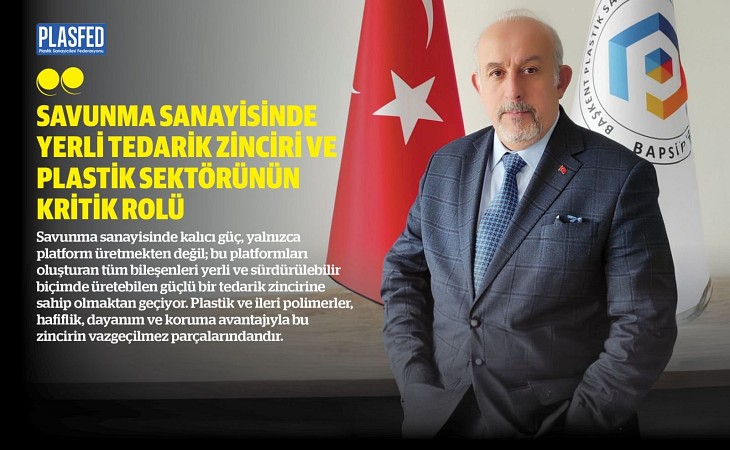
Lasting power in the defense industry does not come solely from producing platforms; it comes from having a strong supply chain capable of producing all the components that make up these platforms in a domestic and sustainable manner. Plastic and advanced polymer technologies, with their lightness, high strength, and protective performance, directly support strategic independence as one of the critical and indispensable elements of this chain.
Mehmet Hakan ATALAY
Capital Plastic Industrialists and Business People Association (BAPSİD)
Chairman of the Board
Increasing geopolitical risks on a global scale, supply chain vulnerabilities, and technological competition have further increased the strategic importance of domestic and national production capacity in the defense industry. The progress Turkey has made in the defense field in recent years has been possible not only through the success of main contractor companies but also thanks to a strong, integrated, and sustainable domestic supply chain positioned behind them. One of the often invisible but vital actors of this ecosystem is the plastic and advanced polymer technologies sector.
In the defense industry, the domestic supply chain is a critical security element in terms of strategic independence, operational continuity, and technological depth. The plastic sector, thanks to its features such as lightness, high strength, ballistic protection, chemical resistance, and compatibility with electronic systems, constitutes one of the indispensable links of this chain. For a strong defense industry, producing the platform alone is not enough; even the smallest component that makes up that platform must be produced with domestic resources and high-quality standards.
Domestic Supply Chain: A Strategic Security Issue Foreign dependency in the defense industry harbors operational and political risks beyond being an economic problem. Embargoes, export restrictions, or supply delays that may occur in critical sub-systems or components can disrupt delivery schedules and directly affect operational capabilities in the field.
In Turkey, the Presidency of Defense Industries plays a central role in the coordination of this process. The Presidency aims to increase the indigenization rate by establishing a strong cooperation network between main contractors and SMEs.
Within this structure, main contractors such as ASELSAN, TUSAŞ, ROKETSAN, and HAVELSAN carry out an integrated production model with hundreds of subcontractors and domestic suppliers. Plastic and composite manufacturers also form a significant part of this network.
Plastic Technologies in the Defense Industry
In modern defense systems, plastics and engineering polymers are not just complementary materials, but performance-enhancing strategic components.
Reducing weight in land, air, and sea platforms is critical for fuel efficiency, range, and maneuverability. High-performance polymers and composites offer high strength compared to metals despite being lighter.
Advanced polymer composites provide effective protection in personnel protective equipment, armor systems, and housing structures due to their high energy absorption capacity.
Strategic Contribution of Domestic Production
Strengthening domestic plastic production reduces foreign dependency in defense projects while providing significant contributions from an economic perspective.
Together with sub-sectors such as mold making, machinery production, recycling, and raw material processing, the plastics industry creates a broad employment area. Companies integrated into defense projects increase the qualified workforce through high value-added production.
The plastic and advanced polymer technologies sector is in a position that directly affects the performance of defense systems in many critical areas, from lightness to ballistic protection, and from electronic compatibility to environmental durability. Consequently, the permanence and sustainability of Turkey's rise in the defense industry are directly related to the presence of a high-tech, competitive, and domestic plastic sector alongside strong main contractors. As every link of the domestic supply chain is strengthened, strategic independence will be solidified to the same extent.
This content has been translated using artificial intelligence technology.