























STRENGTHENING PRODUCTION
IS STRENGTHENING
TURKEY'S FUTURE
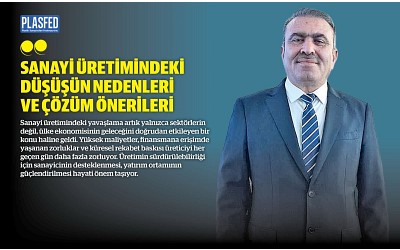
Industry is not only the cornerstone of economic growth, but also of employment, exports, technological development, and strategic independence. However, today the production economy is facing multifaceted pressure caused by difficulties in accessing finance, high costs, raw material dependency, global uncertainties, and the lagging of the exchange rate against inflation. In order to ensure sustainable growth by preserving production power, policies that prioritize industry, strengthen the investment environment, increase predictability, and support competitiveness are needed now more than ever.
Developments in the global economy in recent years have once again demonstrated how strategic an element production is. Supply chain disruptions starting with the pandemic, energy crises, geopolitical tensions, and rising protectionism in global trade have increased the importance of countries that engage in production while making the sustainability of industry one of the most critical agenda items.
Turkey gained a significant advantage in this process with its strong production infrastructure and dynamic industry. However, at the point we have reached today, domestic economic conditions as well as global developments are becoming decisive on production. In particular, difficulties in accessing finance, high loan costs, dependency on raw materials, and the fact that the exchange rate remains behind inflation directly affect the competitiveness of industrialists.
For the production economy to function properly, there is a need for an industrial structure that can invest, plan, and foresee the future. Yet under current conditions, many businesses are forced to postpone their investment decisions. Today, industrialists are trying not only to produce, but also to manage rising costs.
ACCESS TO FINANCE IS THE KEY TO PRODUCTION
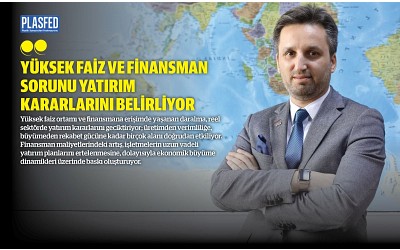
Access to finance continues to be one of the most critical topics regarding the sustainability of industrial investments. Especially for SMEs engaged in production, the persistence of high loan costs makes managing working capital increasingly difficult day by day.
In an environment where manufacturing companies cannot reach finance, it is not easy to talk about capacity increases, technology investments, and export targets. To support production, it is of great importance to make investment loans accessible, develop long-term financing models, and prioritize production-oriented businesses.
To the extent that an industrialist can invest, they create employment, realize exports, and produce added value. Therefore, finance is not only an economic tool, but also an inseparable part of production policy.
THE RISK OF PREMATURE DEINDUSTRIALIZATION
SHOULD NOT BE IGNORED
One of the most significant risks for developing countries is premature deindustrialization... The loss of industry's weight in the economy before production capacity is sufficiently strengthened can turn into a major structural problem limiting growth potential in the long run.
For Turkey to achieve its development targets, the share of industry in the national income must be preserved and even increased. While economies moving away from production struggle to close foreign trade deficits, countries engaged in high value-added production attain a much stronger position in global competition.
Therefore, industrialization policies need to be addressed with a long-term perspective. Policies that do not push production to the background, but rather encourage production, hold strategic importance for Turkey's future.
EXCHANGE RATE AND COMPETITIVENESS
One of the most frequently voiced issues recently by export-oriented sectors is that the exchange rate lags behind inflation. While production costs are rising rapidly, export revenues failing to increase at the same rate weakens competitiveness in international markets.
While energy, labor, logistics, and financing expenses are continuously increasing, the limited movement in the exchange rate reduces the profitability of exporting companies. This situation negatively impacts not only current exports but also new market investments.
For Turkey to sustain its export-driven growth model, an economic framework that balances production costs, protects competitiveness, and increases predictability must be established.
RAW MATERIAL DEPENDENCY IS A STRATEGIC ISSUE
One of the most important structural problems for the plastics industry is the persistence of foreign dependency in petrochemical raw materials. Meeting the majority of raw materials through imports directly reflects global price movements onto the sector's costs.
Changes in energy prices, freight costs, and geopolitical developments reduce predictability in raw material supply. Therefore, increasing domestic petrochemical investments, evaluating secondary raw materials obtained from recycling more effectively, and strengthening circular economy practices hold strategic importance.
The plastics industry is not just a sector carrying out its own production. It constitutes an indispensable link in the production chain of dozens of sectors ranging from packaging to automotive, white goods to agriculture, and the defense industry to healthcare. Therefore, strengthening the plastics sector means strengthening the entire Turkish industry.
PRODUCTION IS TURKEY'S STRONGEST
COMPETITIVE ADVANTAGE
Today, the world is once again discussing the value of production. The diversification of supply chains, the strengthening of nearshoring concepts, and the green transition process present significant opportunities for Turkey.
Capitalizing on these opportunities is possible with a strong industrial policy. Financing mechanisms supporting production, competitive energy costs, regulations strengthening the investment environment, and long-term policies prioritizing industrialization will support Turkey's goal of becoming a global production hub.
Production is not just an activity taking place in factories; it is the foundation of prosperity, employment, and economic independence. Countries that strengthen their industry also secure their future. I believe that when Turkey's production culture, entrepreneurial strength, and industrial experience are supported by the right policies, it will achieve a much stronger position in global competition.
PROTECTING PRODUCTION MEANS PROTECTING TURKEY'S COMPETITIVENESS
The plastics industry is one of the strategic areas of Turkish industry with a production capacity of approximately 10 million tons, an economic size of over 50 billion dollars, and intermediate goods provided to more than 45 sectors. However, the sector is undergoing a major competition test due to high financing costs, imported raw material dependency, rising energy expenses, and exchange rate pressures on exports. Despite this, thanks to its flexible production capability, strong export infrastructure, and high adaptation capacity, it continues to produce, invest, and create employment. Turkey's preservation of its production power depends on the resolute continuation of policies that support industry, strengthen the investment environment, and increase competitiveness. Because a strong industry means a strong economy; and a strong economy means a strong Turkey.
This content has been translated using artificial intelligence technology.