




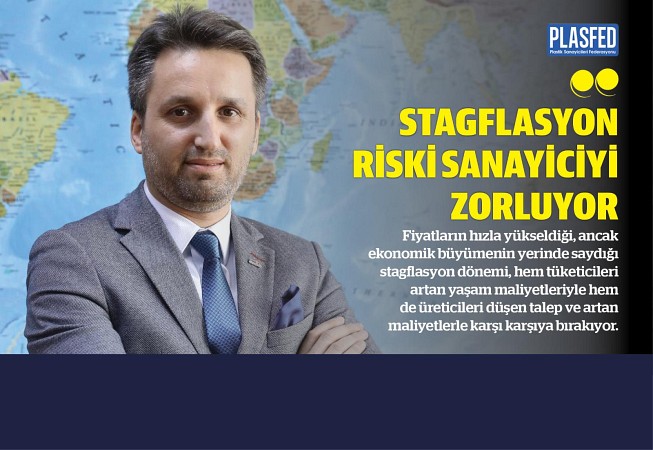
Risk of stagflation in the economy:
Prices rise, economic activity slows
Selçuk GÜLSÜN
Vice President of the Plastic Industrialists and Businessmen Association (PLASİAD)
Periods of stagflation, where prices rise rapidly while economic growth stagnates, confront both consumers with increasing living costs and producers with dropping demand and rising costs. This complex scenario forces economic management to strike a delicate balance between fighting inflation and supporting growth.
Today, the risk of stagflation is becoming increasingly evident in many economies. Stagflation refers to a situation where prices rise rapidly in an environment of slowing or stagnant economic growth. This creates an unusual dynamic in the economy and poses a serious challenge for policymakers. Normally, high inflation is observed alongside a rapidly growing economy, whereas in stagflation the relationship is the opposite. Rising prices increase costs for both consumers and producers, while the slowdown in economic activity leads to decreased incomes and increased unemployment. As a result, living standards decline and economic dynamics are harmed.
THE MAIN CAUSES OF STAGFLATION
Stagflation is often determined by shocks on the supply side. Sudden increases in energy and raw material prices, in particular, raise production costs, pushing up the general price level. At the same time, these cost increases can limit firms' production capacities or drive product prices to levels that consumers cannot afford. On the demand side, seen contractions also negatively affect economic growth. With rising inflation, consumer spending decreases, firms' appetite for investment declines, and thus economic activity slows. This dual pressure forms the basic dynamics of stagflation.
ECONOMIC AND SOCIAL IMPACTS
The effects of stagflation on the economy are quite negative. From the consumers' perspective, rising prices increase living costs, while the slowing economy leads to rising unemployment and income losses. This situation results in a loss of welfare across large segments of society. The business world must contend with both rising costs and the need to maintain profitability in an environment of weak demand. This dilemma leads businesses to delay or scale down their investment decisions. Additionally, from a monetary policy perspective, stagflation creates a significant dilemma. Raising interest rates to reduce inflation further suppresses economic growth, while keeping interest rates low could allow price increases to spiral out of control. Therefore, combating stagflation requires the implementation of policies with a careful balance.
The steps taken by policymakers in this challenging scenario are critically important. Firstly, overcoming constraints on the supply side, increasing energy efficiency, and expanding production capacity can reduce the effects of stagflation. At the same time, monetary policy tools should be employed with careful consideration of the delicate balance between inflation and growth. From a fiscal policy perspective, especially increasing supports aimed at low-income groups and implementing structural reforms contribute to economic recovery. All these measures should aim to ensure both price stability and revive economic activity.
STAGFLATION IS A DIFFICULT PHENOMENON TO MANAGE
In conclusion, stagflation is a difficult process to manage due to both rapid price increases and slowing growth in the economy. Current global conditions, fluctuations in energy prices, and the challenges in the post-pandemic recovery process increase the risk of stagflation. Therefore, policymakers need to adopt multifaceted and proactive strategies to both control inflation and support economic growth. Otherwise, the negative effects of stagflation can spread widely across society, and economic stability can be seriously undermined.
Translated by Artificial Intelligence