




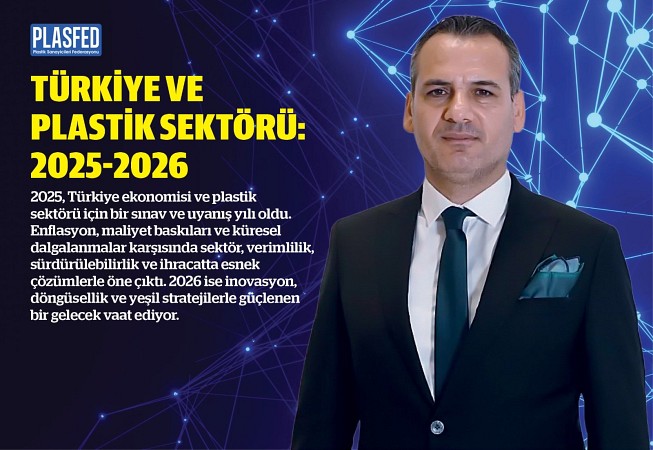
2025 was a year of trial and awakening for the Turkish economy and the plastics sector. Faced with inflation, cost pressures, and global fluctuations, the sector stood out with flexible solutions in productivity, sustainability, and exports. 2026, on the other hand, promises a future strengthened by innovation, circularity, and green strategies.
Efe GÖKÇE
Green Business Platform
Editor-in-Chief
The year 2025 was a period when a long-felt change for the Turkish economy materialized, policy preferences became clear, and the pursuit of stability permeated all sectors. This year was etched into memory as one where the fight against inflation took center stage, and the return to traditional policy tools reshaped economic psychology. High interest rates, cooling domestic demand, and a slowdown in growth are actually seen as the necessary costs of a healthy normalization process. This challenging but necessary backdrop served as a canvas showcasing all the colors of the economy, their shades, and their resilience. And on this canvas, the plastics sector stood out as one of the most vibrant and dynamic colors.
Plastics are among the nerves of Turkey's manufacturing industry, much like steel. In 2025, these nerves exhibited incredible flexibility against global fluctuations, cost pressures, and domestic market transformation. The sector did not merely survive; it caught the winds of transformation and filled its sails for new routes. The cost inflation generated by the inflationary environment forced companies to find more creative solutions in productivity, energy saving, and waste management, while also pushing the sector to internalize that the circular economy is not just a "slogan" but a "survival strategy."
Exporters opened up to new markets
On the export front, the traditional strength of the Turkish plastics sector was crowned by opening up to new markets. While maintaining its strong presence in the European market, fragilities in global supply chains and new quests opened up opportunities for our companies across a spectrum from the USA to Africa, from the Middle East to Latin America. The Turkish manufacturer's ability for fast, flexible, and quality-focused production became the key to its positioning as a reliable supplier in these geographies. This situation meant that the sector increased its dependence on foreign markets, rather than reducing its external dependence.
However, perhaps the most lasting legacy of 2025 was the beginning of sustainability becoming ingrained in the sector's DNA. The regulations brought by the EU Green Deal are no longer a distant threat but have descended to factory floors, R&D laboratories, and product design processes. The use of recycled raw materials began to be seen not as a cost item, but as a competitive advantage and a market entry ticket. This was a strategic evolution that reduced the sector's environmental footprint while also extending its economic life.
So what will 2026 bring us?
For the Turkish economy, 2026 could be a year when the fruits of the strict measures taken in 2025 begin to be reaped. The consolidation of the downward trend in inflation could pave the way for a more lasting improvement in consumer and investor confidence. This environment is also setting a new stage for the plastics sector. Competition will now be shaped by innovation, smart material development, and green identity, rather than price. Circularity will cease to be a "sign of good intentions" and transform into a "business model" directly affecting profitability and market share.
In conclusion, 2025 was a year of trial, resilience, and also awakening for Turkey and its plastics sector. While experiencing transitional pains, our sector grasped clues for a stronger presence in the global arena. 2026 holds the potential to be a concrete step towards a more stable, innovative, and sustainable future by following these clues. Challenges may not end, but our capacity to cope with these challenges became the most valuable treasure that 2025 brought us.
This content has been translated using artificial intelligence technology.