




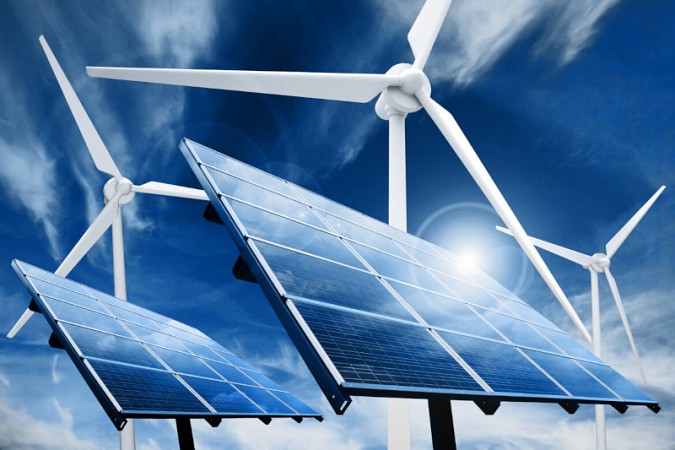
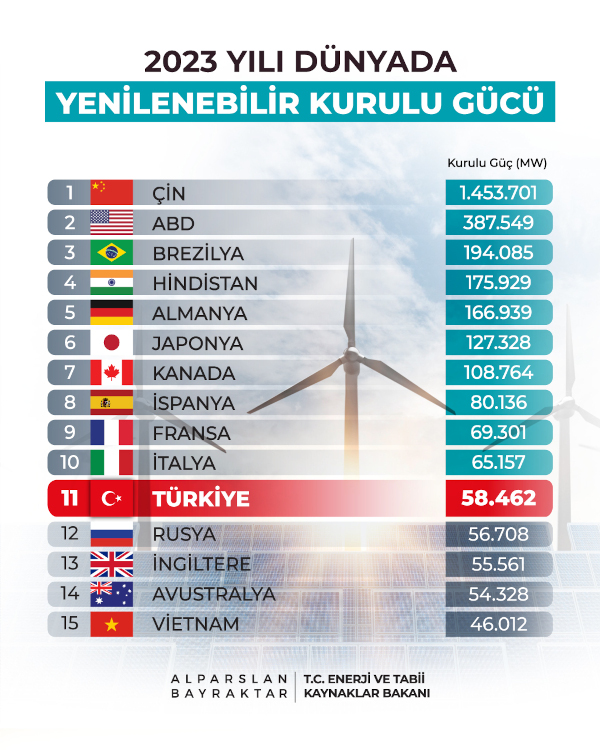
According to the installed capacity statistics published by the International Renewable Energy Agency’s, Turkey rose to 11'th place in renewable energy installed capacity. Rapidly climbing the ranks in the world, Turkey is in fifth place in Europe. Research shows that Turkey's rapid growth in renewable energy in recent years has seized significant opportunities in this field.
As energy demand increases daily worldwide and in Turkey, the limited resources of fossil fuels and the damage they cause to the environment encourage countries to turn to renewable energy sources. Wind and solar energy stand out among these renewable sources and hold great potential as future energy solutions. More and more countries are adopting environmentally friendly and sustainable energy policies, striving to reduce their carbon footprint and increase energy security.
Renewable energy plays a critical role for countries in combating climate change and ensuring energy security. Renewable energy presents itself as a highly sensitive issue for countries to reduce their dependence on fossil fuels, meet their own energy needs, and diversify resources to obtain sustainable energy. Furthermore, renewable energy holds an important place in minimizing environmental damage. Despite the high level of fossil fuel use globally, investments in renewable energy are gradually increasing with growing environmental and climate awareness.
High energy consumption negatively impacts companies’ production and operational costs, leading to an increase. Minimizing energy consumption costs, which negatively affect the sales and profitability of produced goods or services, is crucial for companies. At this point, companies need to be able to meet their own energy needs and create an infrastructure that will enable this. Companies that can produce energy with renewable energy sources gain a competitive advantage by creating a sustainable structure.
Rapidly increasing population and developing industry are rapidly increasing the demand for energy. Limited resources are causing the gap between production and consumption to grow. Global energy consumption is estimated to double the amount consumed in 1998 by 2035 and triple it by 2055.
On the other hand, “non-renewable,” traditional energy sources such as oil, natural gas, coal, and nuclear energy have increasingly become a threat to the environment and human health. The widespread use of traditional energy sources, particularly in the transportation, residential, and industrial sectors, further complicates the problem. For example, 95% of energy consumption in the transportation sector is met by oil. This rate is expected to increase by 1.5% annually in developed countries and 3.6% in developing countries within the next five years.

Fossil fuels cause climate change
The amount of carbon dioxide (CO2) released from the burning of fossil fuels is gradually increasing due to deforestation. This prevents the reflection of solar radiation along with other gases in the atmosphere. Thus, the “greenhouse effect” occurs, causing climate changes. It is argued that if global warming continues to increase in this manner, sea levels will rise by up to one meter by 2040, in which case the world’s largest cities will be submerged.
Alongside all these developments, with the estimation that oil will be depleted within 50 years and natural gas within 200 years, humanity has turned to the search for nature-friendly, clean, and relatively cheap energy sources. In this context, the increased use of “renewable energy sources,” which are “sustainable” in terms of time and capable of existing in every region of the world, is attracting attention.
Increase in electricity demand
According to PwC Turkey’s published “Turkey Electricity Market Overview 2023” report, it was noted that Turkey has shown rapid growth in renewable energy in recent years and that there are significant opportunities in this area. The report points out that very important developments have occurred in the Turkish electricity sector over the last three years, and that following a decrease in consumption due to the COVID-19 pandemic, as in many countries, a significant increase in electricity demand has been recorded in Turkey starting from 2021, influenced by increasing economic activity and deferred consumption.
The study emphasizes that Turkey, along with Europe, was affected by rising electricity prices throughout the last quarter of 2021 and 2022, explaining that in addition to the increasing electricity prices during this period, the depreciation of the Turkish Lira increased the impact of electricity prices on inflation.
Share of renewable energy is increasing
In PwC’s published “Turkey Electricity Market Overview 2023” report, it was highlighted that the market is in a late growth phase, and Turkey's Green Transformation commitment was most clearly laid out in the National Energy Plan prepared in May 2022. According to the research, the share of installed capacity in renewable energy in Turkey, which was 53% as of June 2023, is estimated to be 65% in 2035. Solar energy is projected to have the largest share, 53%, within the renewable installed capacity.
Furthermore, among the notable goals in the National Energy Plan, the objective of reducing dependence on thermal energy and sustainably increasing the share of renewable energy in electricity generation beyond 2030 stands out.
It is estimated that Turkey’s annual electricity consumption will exceed 500 TWh in 2035, and the industry and service sectors will account for more than 50% of Turkey’s annual electricity consumption.
There are 20 companies in Turkey with more than 250 MW of installed capacity based on renewable sources. While these companies primarily operate hydroelectric power plants, the scarcity of large market players investing solely in wind, solar, and geothermal power plants is noteworthy.
Turkey, Europe’s fifth largest country
While installed renewable energy capacity in Europe increased by 6.6% since 2011, reaching 765 GW in 2022, Turkey, with current data, has the fifth largest renewable energy installed capacity in Europe. Turkey ranks third in Europe for the increase in renewable energy installed capacity over the last six years. In the hydroelectric energy capacity ranking, it comes second after Norway in Europe.
The report also emphasizes that improved storage techniques, diversification of import sources, and flexibility in the natural gas network strengthen Turkey's position in negotiations with suppliers. The research, which also covers the growth of the electric vehicle market in Turkey, highlights that while passenger car sales in Turkey remained relatively stable between 2020 and 2022, the share of electric vehicles in total annual passenger car sales steadily increased from 0.1% to 1.1% during the same period.
Minister Alparslan Bayraktar:
“2035 target: 60 thousand MW installed capacity”
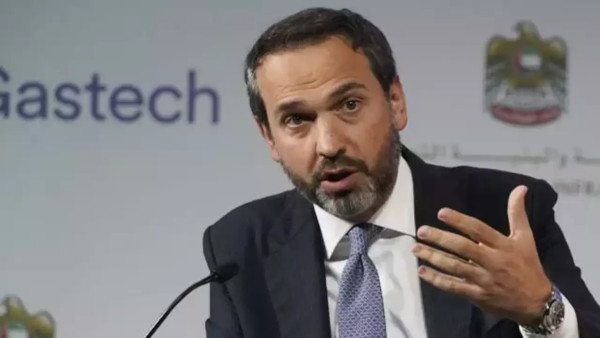
Minister of Energy and Natural Resources Alparslan Bayraktar stated that Turkey has entered the world’s top 11 in renewable energy installed capacity and ranks fifth in Europe.
According to the installed capacity statistics published by the International Renewable Energy Agency (IRENA), Turkey rose to 11'th place in renewable energy installed capacity. China ranked first, followed by the USA and Brazil. This trio is followed by India, Germany, Japan, Canada, Spain, France, and Italy. Turkey is in 11’th place with 58,462 MW. Russia, the United Kingdom, Australia, and Vietnam follow Turkey. Turkey was previously in 12’th place.
Minister of Energy and Natural Resources Alparslan Bayraktar stated that Turkey has entered the world’s top 11 in renewable energy installed capacity and ranks fifth in Europe. Bayraktar noted that Turkey is moving with the goal of bringing its solar, wind, hydraulic, and geothermal resources, all its renewable resources, into its economy within a certain program, and announced that they want to commission 5,000 MW of installed capacity in renewable energy annually. Emphasizing that they aim to reach a total new installed capacity of 60,000 MW over 12 years until 2035, with 3,500 MW in solar and 1,500 MW in wind, Alparslan said, “As of April 2024, we have exceeded 1,400 megawatts. We will certainly reach the 5,000 MW target by the end of the year. Of the total 110,000 megawatts of installed capacity, 25,000 megawatts are constituted by solar and wind energy. Our 25,000 MW installed capacity will increase to 30,000 by the end of the year, reach 35,000 in 2025, and thus, our target set until 2035 is for this 25,000 MW to go up to approximately 90,000 MW.”
Bayraktar noted that electricity produced from renewable sources both prevents imports and brings Turkey step by step closer to its 2053 Net Zero Carbon target, adding that every kilowatt-hour of electricity produced from renewable sources means a reduction in imported natural gas, coal, and oil.
Turkey attracts attention with solar energy investments
According to the Energy Sector Report 2024 research by KPMG, another international consulting firm, the most important developments in Turkey’s energy market in 2024 include the increase in renewable energy capacity and steps towards carbon reduction targets. Particularly with solar energy investments, Turkey is attracting attention in the field of renewable energy. The report states that Turkey’s investments in renewable energy sources promote sustainability and that regulations in this area are making the energy market more competitive. In 2024, 30% of energy investments made in Turkey were allocated to renewable energy projects. Additionally, mechanisms such as YEKA projects and carbon emissions trading have been implemented. Turkey is taking significant steps in terms of renewable energy investments. Sources such as solar, wind, hydroelectric, and geothermal play a critical role in Turkey’s energy future. In 2024, 30% of total energy investments made in Turkey were directed towards renewable energy projects.
This content has been translated using artificial intelligence technology.