


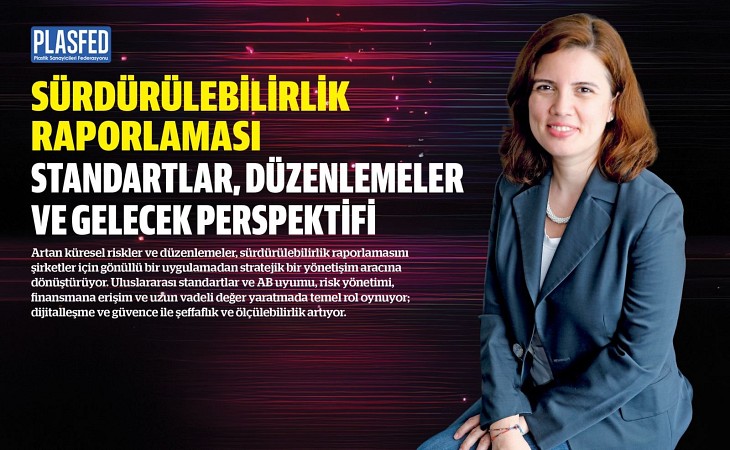
Increasing global risks and regulations are transforming sustainability reporting from a voluntary practice into a strategic governance tool for companies. Reporting in line with international standards and EU regulations is becoming a fundamental element of risk management, access to finance, and long-term value creation. This process enables companies to reshape their decision-making mechanisms with a focus on sustainability, while creating a more measurable and transparent structure through digitalization and assurance practices.
Gülberk ERTAP KAYA
Sustainability Manager
The ever-increasing environmental, social, and economic uncertainties make it mandatory for companies to report their financial performance along with their non-financial impacts. In this process, as the importance of the capacity to create long-term value grows, it becomes critical for companies to integrate their sustainability strategy into their corporate strategy. Sustainability reporting allows companies to present their approaches in this area to their stakeholders.
Sustainability reporting, which ensures that non-financial performance is visible in a systematic, comparable, and verifiable manner, also plays an active role in decision-making processes in areas such as risk management, compliance, investor relations, and stakeholder communication. For all these reasons, it also holds an important place in terms of corporate governance.
This article aims to address the importance of sustainability-oriented transformation for companies, the role and impacts of reporting in this process, and current developments in this field.
Sustainability-oriented transformation
Climate change, depleting natural resources, and increasing social inequalities are increasing economic, social, and environmental risks while causing the global economy to undergo a structural transformation process.
The sustainability-oriented transformation approach, which proposes re-evaluating the concept of economic growth in harmony with the limits of nature and social welfare, also emphasizes that strategic priorities, decision-making mechanisms, and business models must be reviewed in conjunction with the energy transition and the transformation of production technologies.
In this context, elements such as climate change, energy supply security, geopolitical uncertainties, disruptions in the supply chain, and talent management are becoming as important as financial fluctuations for companies' current and future performance. For this reason, companies need to increase their sustainability-oriented transformation capacity.
Proactively analyzing economic, social, and environmental risks, addressing corporate strategy with this approach, setting goals, and taking action are among the main steps in this process. Stakeholder communication based on transparency is of great importance in maintaining a successful process in the long term.
The role of sustainability reporting in transformation
Sustainability reporting enables companies to plan their transformation processes by presenting their environmental, social, and governance performance with measurable data. Seeing the current situation in areas such as carbon footprint, resource efficiency, and social impact facilitates the setting of strategic goals.
This process makes performance visible while contributing to early detection of risks, increasing corporate awareness, and embedding sustainability goals into corporate culture. Furthermore, transparent reporting facilitates access to finance, lowers the cost of capital, and supports companies' preference in global supply chains.
International standards and regulations
Global standards in sustainability reporting ensure that companies prepare their reports within a common framework and allow for the comparison of data across different countries. The Global Reporting Initiative (GRI), one of the most common frameworks, enables companies to report their environmental, social, and economic impacts in a standard format.
The International Sustainability Standards Board (ISSB) under the IFRS Foundation, which strengthens the investor-oriented reporting approach, focuses on the disclosure of financial risks and opportunities related to sustainability. The ISSB’s IFRS S1 and IFRS S2 standards support investor decision-making processes by ensuring that company performance is comparable on a global scale.
The EU's new sustainability reporting regime and its effects on companies
On the other hand, various regulations regarding reporting requirements implemented within the scope of the European Green Deal also affect companies through supply chains. In this context, the Corporate Sustainability Reporting Directive (CSRD) was adopted by the EU in 2022. Additionally, the Corporate Sustainability Due Diligence Directive (CSDDD), which was presented as a draft in 2022, was published in 2024.
The European Sustainability Reporting Standards (ESRS), which are one of the main implementation tools of the CSRD, which obliges companies of a certain size operating in the EU to identify the environmental and social impacts of their activities and to disclose these impacts to the public, were adopted in 2023. However, there are some postponements and simplifications in the processes related to some regulations implemented by the EU in 2025.
Türkiye sustainability reporting standards
One of the most fundamental challenges for companies in the reporting process is the need to comply with reporting demands from different frameworks. Therefore, the preparation of ESRS by considering the principle of interoperability with ISSB and GRI is an important element that facilitates the process for companies. In parallel with these global efforts, the Turkish Sustainability Reporting Standards (TSRS) have come into force in Türkiye.
With the Board Decisions regarding implementation taken by the POA (Public Oversight Authority), sustainability reporting has been made mandatory for businesses that exceed the thresholds determined by taking into account criteria such as the number of employees, total assets, and net sales revenue. The POA adopted the internationally recognized international sustainability reporting standards (S1 and S2) published by the ISSB, naming them TSRS 1 “General Requirements for Disclosure of Sustainability-related Financial Information” and TSRS 2 “Climate-related Disclosures,” and prepared the relevant legislation.
With this development, which shows that Türkiye has established a reporting infrastructure integrated with international standards, sustainability reporting has become a regulatory compliance responsibility beyond a practice based on the principle of voluntariness for companies.
Conclusion
Today, sustainability reporting is a strategic management tool that affects risk management, compliance, and access to finance processes, in addition to presenting past activities to the information of stakeholders. With global and national regulations, reporting is also becoming a critical element for corporate governance. In the coming period, sustainability reports are expected to gain a more data-driven, integrated, and forward-looking structure. Companies that manage this process effectively gain a competitive advantage and also obtain a significant advantage in strengthening their long-term value creation capacity.
References
Dwomor, Emmanuel and Mensah, Emmanuel (2024) "The Role of Cost of Capital in the Link Between ESG Reporting And Firm Performance," Jurnal Akuntansi dan Keuangan Indonesia: Vol. 21: Iss. 2, Article 5. DOI: 10.21002/jaki.2024.11
EFRAG, https://www.efrag.org/en/sustainability-reporting/esrs-workstreams/interoperability, Access Date: 12.01.2026
EU strikes deal to weaken corporate sustainability laws, M.Dey ve K. Abnett, https://www.reuters.com/sustainability/climate-energy/eu-strikes-deal-further-weaken-corporate-sustainability-laws-2025-12-09/, Access Date: 12.01.2026
Global Reporting Initiative, https://www.globalreporting.org/, Access Date: 12.01.2026
IFRS Foundation, https://www.ifrs.org/, Access Date: 12.01.2026
Public Oversight Accounting and Auditing Standards Authority, https://kgk.gov.tr/surdurulebilirlik, Access Date: 14.01.2026
Siyang Hu, Chongyan Zhang, (2025) “ESG disclosure quality, supply chain resilience, and corporate performance”, Finance Research Letters: Volume 85. Part E. 108219, ISSN 1544-6123. https://doi.org/10.1016/j.frl.2025.108219 .
Ministry of Trade, https://ticaret.gov.tr/dis-iliskiler/yesil-mutabakat/surdurulebilir-finansman/kurumsal-surdurulebilirlik-raporlama-direktifi, Access Date: 12.01.2026
Ministry of Trade, https://ticaret.gov.tr/dis-iliskiler/yesil-mutabakat/ab-dongusel-ve-surdurulebilir-sanayi-politikalari/kurumsal-surdurulebilirlik-ozen-yukumlulugu, Access Date: 12.01.2026
This content has been translated using artificial intelligence technology.