




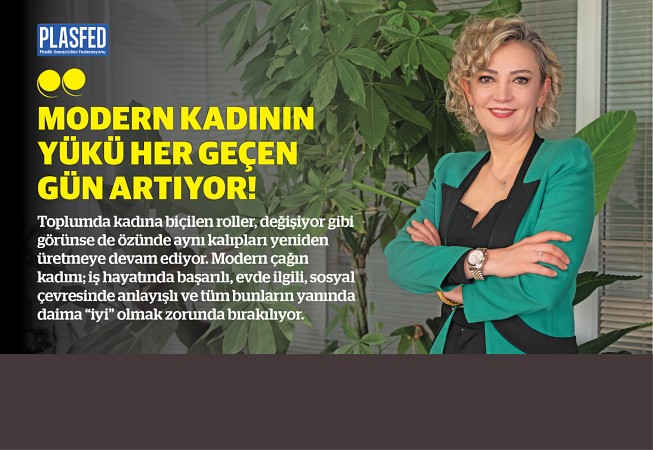
Although the roles assigned to women in society seem to be changing, they continue to reproduce the same patterns at their core. The modern woman is expected to be successful in her professional life, caring at home, understanding within her social circle, and above all, to always be 'good'. So, how can women manage to be themselves amidst these multiple roles? We discussed the psychological effects of gender roles on both women and men, the phenomenon of burnout, and how women's most basic needs have turned into luxury with Ebru Özer, the founder of 5N1K Psycho Academy, PhD candidate, and family counselor.
The roles imposed on women may seem equalized in the modern era, but in reality, they are merely changing form. This journey, from being docile children to self-sacrificing mothers, understanding wives, and successful career women, leaves deep marks on women's psychological worlds.
“Being a woman is an art of balance, but this balance often feels like finding your way through a labyrinth woven with invisible rules. Every corner presents a different expectation, with a new role at every turn,” says Ebru Özer, reflecting on her more than 15 years of professional experience. She explains how women cope with the emotional labor that goes unnoticed and the ideals of the 'superwoman' that modern society imposes.
In this in-depth interview with Özer, we take a closer look at women's real needs and the individual identity searches that remain shrouded in gender roles.
What should we understand when we say the place of women in society?
Talking about a woman's 'place' is problematic because this expression confines her to a fixed role. Yet, women are the living blood of society. However, this blood flows within the boundaries drawn by men. We are the women who were taught to 'behave' as children, and are seen as 'too ambitious' in the workplace. While a man's confidence earns admiration, similar behavior in women can be viewed as 'arrogance'.
Why do women burn out while trying to be perfect?
Because the modern world has offered us an illusion: the promise that 'You can have it all!' But we didn't read the footnote: 'Just not all at the same time!' Women who entered factories with industrialization continue to carry the responsibilities at home. Today, a woman must be 'professional' at the office while also being the first to respond to a teacher calling from school. The result? A chronic feeling of 'lack'.
Do gender roles limit only women?
No, gender roles actually chain everyone. While men are taught to 'control their emotions', they are really learning to 'deny' them. A mindset that says 'men don’t cry' also implies that 'men don’t take care of children'. However, fathers who engage in parenting and household chores not only lighten their wives' burdens but also rediscover themselves. Ultimately, these molds that impose 'strong yet gentle' on women and 'emotionless but protective' on men rob all of us of our freedom. While women feel guilty for saying 'I can't', men grow isolated because they feel 'I can't feel'. If only we could experience all the colors of being human—being emotional yet strong, compassionate yet decisive...
How do traditional roles assigned to women and men affect our psychology?
These impositions are like a double-edged sword... While women burn out saying 'I can't', men grow isolated saying 'I can't feel'. For instance, when a mother misses her child's school event, she feels guilty, while the father remains silent out of fear that showing emotions will make him appear weak. Yet, true closeness begins when we can break through this armor.
On the other hand, this question summarizes the deadlock that my female clients frequently express during sessions. Society constantly imposes 'you must do', yet it never discusses 'what happens if you can’t do anything?'. A woman striving to get to work on time thinks she's 'not a good enough mother', and when she cannot spend time with her child in the evening, she believes she’s 'selfish in her career'. This vicious cycle creates a chronic sense of 'never being able to do anything fully.'
So how do women manage to exist within the masculine societal structure? Where is the place for love, compassion, and tenderness within gender roles?
Women have survived the pressure of patriarchal oppression throughout history through quiet resistance. However, this struggle for existence is often hidden under the burden of 'emotional labor'. While society expects love and compassion from women, it has coded these traits as her 'natural role'. However, compassion should not be a unilateral sacrifice but a relational interaction. When a woman realizes the 'emotional exploitation' imposed by the patriarchal system, feelings of anger and burnout become unavoidable.
Ms. Özer, what exactly do you mean by 'emotional labor'? How does it show up in daily life?
Think about it: a flight attendant smiles at an angry passenger while storms are raging inside her, or a mother, tired from work, patiently helps her child with homework. This is the state of 'role-playing' where we suppress our emotions. Women do this so much at work and at home that they often don't even realize it.
Why does this situation particularly affect women?
Because society tells women, 'You are naturally caring and patient.' It’s no accident that women dominate professions such as nursing and teaching. The same applies at home: the one who listens to her husband's stress and manages the child's crises is always the woman. It's as if providing emotional support is a woman's natural duty!
What is the cost of this invisible burden?
This cost is paid both mentally and physically. The constant 'good feeling' performance triggers anxiety and burnout. Physical symptoms such as migraines and insomnia come as a result. The saddest part is, after a while, we forget the question, 'How do I really feel?'
Where do men fit in this equation?
They are losing out too. By saying 'real men don’t cry', we are raising individuals who cannot recognize their own emotions. However, a father should be able to hug his child and say, 'I’m sad today.' This estrangement harms relationships and lowers men's rates of seeking psychological help.
What do you say about the perception that 'emotional labor' is 'worthless'?
Isn't it ironic? Society actually needs this the most for its peace. But a nurse's touch to a patient, a teacher's patience is not written in the 'job description'. Yet true humanity lies in being able to say, 'I have no strength today.'
So, how can a woman reclaim her need to 'be herself' amidst all these roles?
The answer lies in a single sentence: Give yourself permission again. First, we must understand this: A woman saying 'I' is not betraying her family or career; rather, it is the only way she can continue healthily in all these areas. The 30 minutes a woman dedicates to herself during the day is actually the price for her to be more patient with her child and more focused on her job. Being able to rest without feeling guilty, being able to say 'no'... These are not selfishness but survival skills. Just as a tree must nourish its roots first, if a woman neglects herself, neither her motherhood nor her career can bear fruit. Remember: a woman is both the root and gardener of this tree called 'womanhood'. She must create space for herself to truly keep up with all roles.
What should be the first step to break this vicious cycle?
A woman starting to see her own needs as 'self-respect' rather than 'selfishness' could be the first step. But only a nourished individual can provide genuine benefit to those around her, because a candle must light itself before it can light others. Only then can the light spread.
What is the secret of a person being able to remain 'themselves'?
Never forget this truth: You are not a role; you are a human being. Motherhood, partnership, career... These can be parts of your life but cannot define you. Allow yourself to sometimes say you’re tired, sometimes say 'no', and sometimes remember the sanctity of simply saying 'I'. Only those who do not lose themselves can truly love and succeed.
What do you think is the most fundamental thing that women lose under the pressure to 'do everything' or the 'superwoman' ideal?
The societal imposition of the 'superwoman' ideal even turns women's most basic human needs into luxuries. A woman deprived of the freedom to say 'I'm tired' lives with a constant fear of performance. Yet true strength lies in accepting vulnerability. What is most lacking in this system is a culture of genuine sharing—both for women to not hesitate to ask for support and for men to be able to say 'I will handle it'. From the right to rest to the freedom to go to the bathroom, even the most basic needs turn into a 'grace'. For women to be able to live their multi-dimensional identities, they must not be confined to the roles of mother-partner-employee. The saddest part is that all this effort remains invisible; while recognition is the most natural need of every human being. The statement 'Nobody asked me what I wanted for 10 years' that I've heard in therapy rooms summarizes this tragedy: Women are expected to give everything, but no one asks them, 'What do you want?'
Translated by Artificial Intelligence