




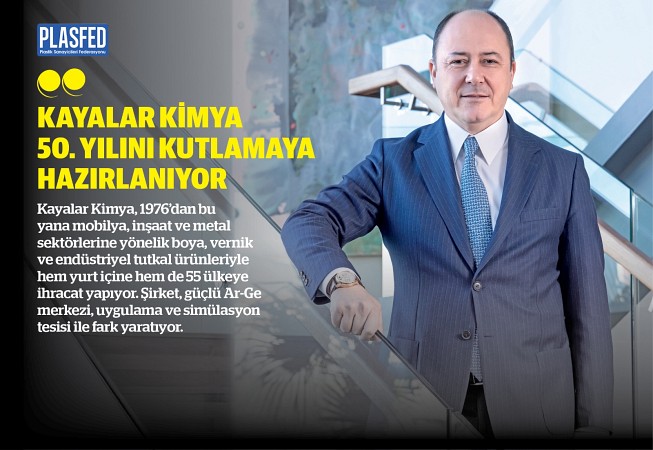
Since 1976, Kayalar Kimya has been producing paints, varnishes, and industrial adhesives for the furniture, construction, and metal sectors, exporting to 55 countries and making a name for itself both domestically and internationally. With a strong R&D center, application, and simulation facility, the company continues to grow in the global market through investments in sustainable production and digital transformation. "Throughout our 50-year journey, we have been a pioneer in our industry with our innovative products and customer-oriented approach," says Ersin Kayalar, Chairman of the Board.
Preparing to celebrate its 50th anniversary in 2026, Kayalar Kimya stands out as one of the leading paint and varnish manufacturers in Turkey and Europe, boasting half a century of experience. Founded in 1976 by Yılmaz Kayalar, the company operates today with a wide product range aimed at the furniture, construction, and metal industries. With powerful brands like Genç, Düfa, Woodsol, and Genç Noroo, Kayalar Kimya reaches a large customer base both at home and abroad, making an impact in the sector through its robust R&D center and application and simulation facility. In addition to its production facilities in Tuzla and Gebze, the company is investing in industrial adhesives and binders, continuing its growth with a sustainability-focused approach.
Ersin Kayalar, Chairman of the Board of Kayalar Kimya, stated, "Today, we are proud to have made Kayalar Kimya a global player, thanks to our exports to 55 countries and our presence in the domestic market. Our journey of 50 years has been marked by innovative products and a customer-focused approach that has established us as leaders in our industry."
We discussed the 50-year story of Kayalar Kimya with Ersin Kayalar...
With 50 years of experience in the sector, Kayalar Kimya holds a significant position. Could you briefly talk about your company's core activities, product groups, and market structure at this point?
As you’ve mentioned, in 2026 we will celebrate the 50th anniversary of Kayalar Kimya. Our company was founded by Yılmaz Kayalar in 1976. Today, we are one of Europe’s largest manufacturers of furniture paints and varnishes. With our brands Genç, Düfa, Woodsol, and Genç Noroo, we provide a wide range of services to the furniture, construction, and metal sectors, producing both solvent and water-based outdoor wood varnishes and paints as well as industrial paints.
Our strong R&D center and the first application and simulation center for furniture paints and varnishes in Turkey allow us to make a difference in the sector. We have two production facilities in Tuzla and Gebze. Our investment in the second factory in Gebze is aimed at producing industrial wood adhesives and binders. We have entered the industrial adhesive sector with the brands KayaColl, KayaTherm, KayaPur, KayaPren, KayaSit, KayaSil, and KayaFlex. We continue to grow in the area of adhesives and binders as well. In all sectors we operate in, we make a difference with our quality, innovative products, and customer-oriented approach, and we are working to maintain this understanding in the new areas we are focusing on.
Can you speak about your foreign trade?
We export to 55 countries. More than half of our total sales come from exports. With our Genç brand, we were included in Turquality in 2016, which is the world's first state-supported branding program. Genç became the first brand in its field to be included in this program. In short, with our successful brands and our impactful projects in the new areas we are focusing on, we aim to continue making a difference with the excitement of our first day and our 50 years of experience.
In recent years, R&D and innovation have become pivotal points in the chemical sector. What strategy is Kayalar Kimya following in this area? Can you provide examples of your new product development or sustainability-based projects?
At Kayalar Kimya, we place great importance on R&D efforts to strengthen our leading position in the industry and ensure long-term sustainable growth. By obtaining our R&D Center Certificate in 2011, we accelerated our investments in this field. To date, we have successfully completed 170 national and international projects.
The foundation of the innovation work we carry out in our R&D center is based on environmental sustainability, physical and chemical durability, aesthetic properties, and the discovery of new areas of use. Specifically for wood paints, we aim to produce paints containing lower volatile organic compounds (VOCs) that are less harmful to the environment and human health. Additionally, we aim to reduce our dependence on petroleum-derived raw materials by using raw materials obtained from biological sources (vegetable oils, natural resins, etc.). Minimizing and recovering waste in paint production processes and applying sustainable production methods are also among our primary goals.
As Kayalar Kimya, you hold a strong position both in the domestic market and in exports. Which countries do you export to? What is the share of exports in your revenues? Are there new target markets in this area?
As Kayalar Kimya, we have established our growth strategy to focus not only on the domestic market but also on exports. As a result, more than half of our revenue now comes from exports. We export to 55 countries across 3 continents. In some of these countries, we lead in the sales of furniture varnish paints just as we do in Turkey. We also have offices, warehouses, and laboratories in various regions. We established our structure in Poland to better serve Europe, and we are seeing positive reflections of this decision. In the upcoming period, we aim to gain more market share in Western Europe, the USA, Asia, the Middle East, and Africa.
Let’s talk about your investments. Do you have any new production facilities, capacity increases, or technology investments that you have implemented or planned recently? If so, can you share the details with us?
As Kayalar Kimya, we are taking significant steps in the field of renewable energy in line with our sustainability targets. We are establishing a Solar Energy Plant in Elazığ. One of our most important recent investments is this solar power plant. It will start production at the beginning of next year and will meet all the energy needs of our production facilities in Tuzla and Gebze. Initially, it will have a production capacity of 6 MWp.
Additionally, we have completed our warehouse investment in our Tuzla factory. At this point, we are focusing on achieving full automation in logistics. As Kayalar Kimya, we are making sustainability the center of all our business processes. We are continuously investing in different areas for the sustainable growth of our company. Thanks to our chemical treatment system in our Tuzla facility, we purify the water we use in production and make it suitable for reuse in our processes. In this way, we reduce our water consumption and minimize our impact on the environment. Additionally, our solvent recovery system significantly contributes to environmental protection. By 2024, we aim to purify 800 tons of contaminated solvent safely, ensuring its reuse without harming the environment. Moreover, with our Drinking Water Treatment Project, we purify our drinking water for use within the facility.
The chemical industry is a strategic area for Turkey's high value-added production goals. In your opinion, what are the biggest advantages and challenges facing the Turkish chemical industry?
The chemicals industry is a strategic area providing final products and intermediate goods to all sectors, as you mentioned. I believe one of the advantages of the Turkish chemical industry is our country’s geographical location. Turkey has a strategic position in terms of logistics due to its proximity to the markets of Europe, Asia, and the Middle East. Turkish chemical products are exported to many countries. The chemical industry consistently leads among the sectors with the highest export figures.
On the other hand, our industry carries the risk of external dependency. I believe it is important to focus more on developing policies that encourage domestic production to reduce dependence on raw materials. Our industry is energy-intensive, and therefore rising energy prices directly impact production costs.
The plastic sector stands out as a significant sub-branch of the chemical industry. Both environmental concerns and the EU's Green Deal processes are affecting this sector. How do you think the plastic sector should prepare for this transformation? How is Kayalar Kimya managing this process?
The plastic sector should shift towards recyclable materials to comply with the Green Deal, invest in eco-friendly and sustainable production technologies, and adopt practices that will reduce its carbon footprint. I believe that waste collection processes in our country also need to be made more efficient. This way, these wastes will return to the system in a reusable form.
At Kayalar Kimya, we are incorporating recycled plastics into some of our packaging, and we are working closely with manufacturers to increase this rate.
Among the basic issues frequently voiced by Turkish industrialists in recent years are energy costs, access to financing, and the shortage of qualified labor. What is your perspective on these topics?
There are challenges with access to financing and qualified labor. Particularly, we as industrialists are struggling to find skilled workers. Following the EYT regulation, many of our experienced colleagues left their jobs. This has resulted in a loss of knowledge and expertise. These colleagues had been role models for the generation following them, teaching processes. I observe that job inefficiency has increased with this change. Additionally, due to the lack of vocational schools, we are insufficient in training qualified labor for our industry. I believe urgent solutions should be found by focusing on these issues. Another issue is as you mentioned in your question, the difficulty in accessing financial resources, and the available financing is often at very high-interest rates.
In your opinion, what is the biggest structural need of the Turkish industry today? What steps should be taken for our industry to be stronger in global competition?
I believe the biggest structural need of the Turkish industry is to shift to high value-added and technological production. To be stronger in global competition, R&D investments should be increased, the focus on training qualified labor should continue, and digital transformation processes should be accelerated. At Kayalar Kimya, we are moving forward by focusing on these issues in our investments and actions.
Translated by Artificial Intelligence