


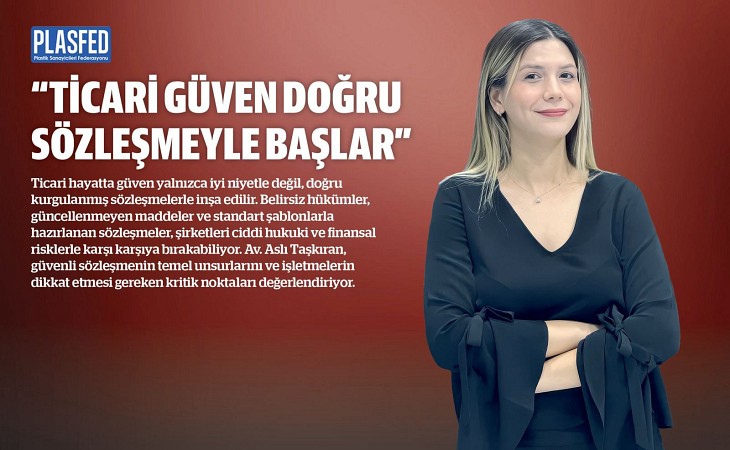
“COMMERCIAL TRUST BEGINS WITH THE RIGHT CONTRACT”
In business life, trust is built not only on good intentions, but on correctly structured contracts. Contracts prepared with vague provisions, outdated clauses, and standard templates can expose companies to serious legal and financial risks. Atty. Aslı Taşkıran evaluates the essential elements of a secure contract and the critical points businesses must pay attention to.
Today, as global trade changes rapidly, supply chains are reshaped, and economic uncertainties increase, a strong contract is no longer just a legal document for companies; it stands out as one of the most important tools of commercial sustainability and risk management. Especially in the manufacturing and plastics industries, contracts prepared for critical processes such as delivery, payment, quality standards, and international trade play a decisive role in preventing potential disputes. In this interview with Atty. Aslı Taşkıran, we discussed the essential elements of a secure contract, the most common mistakes made by companies, and how to take stronger legal steps against changing trade dynamics.
What are the most common mistakes made when drafting contracts in B2B commercial relationships? How can the business world avoid these mistakes?
Among the most common mistakes we encounter when drafting contracts in commercial relationships between companies are proceeding with verbal agreements and using standard contract templates. In addition, failing to clearly write down the obligations of the parties, leaving delivery and payment terms ambiguous, failing to regulate dispute resolution methods, and not updating contracts also create significant risks.
To avoid these mistakes, companies should not prepare contracts with ready-made templates, but in accordance with the specific characteristics of the commercial relationship. The obligations of the parties, deadlines, and dispute resolution methods must be clearly regulated, contracts must be revised at regular intervals in accordance with changing conditions, and support should be obtained from a legal expert in the field throughout the process.
When we say a "secure contract," which essential elements must legally be included?
The concept of a "secure contract" refers to contracts that regulate the rights and obligations of the parties in a clear, predictable, and auditable manner. A secure contract must definitely include the identity information of the parties, the subject and scope of the contract, the price and payment terms, the rights and obligations of the parties, the duration and termination conditions, penalty clauses and compensation provisions, force majeure clauses, the dispute resolution method, and confidentiality and KVKK (Personal Data Protection Law) provisions.
How should contracts be structured in supply chain relationships? How can risks be minimized?
Proper structuring of contracts in supply chain relationships is of great importance in terms of managing commercial and legal risks arising throughout the process from raw materials to the final product, especially in sectors like the plastics industry. Therefore, contracts should be treated not only as documents determining commercial terms, but also as a risk management tool.
In this context, using a framework agreement together with order-based annexes is an effective model. While general terms are determined in the master agreement, elements such as quantity, price, and delivery date are regulated separately in each order; thus, both flexibility is provided and uncertainties are reduced. While adding the right to supplier evaluation and auditing to the contract creates a guarantee in terms of continuity and quality, preserving the possibility of an alternative supplier also reduces the risk of dependency.
To minimize risks, inventory obligations and minimum stock levels must be clearly regulated. Formula-based price revision mechanisms, especially against raw materials price fluctuations, protect the economic balance between the parties.
In addition, chain liability provisions are of critical importance; the effects of delays or defects originating from sub-suppliers must be clearly determined. Furthermore, the delivery method and the moment of the transfer of risk must be clearly regulated to clarify which party bears the responsibility in case of damage, spoilage, or loss of the goods.
What should be taken into consideration when preparing payment, delivery, and penalty clause provisions?
Regarding payment provisions, first of all, the payment term, currency, and currency risk must be clearly determined. Especially in transactions made in foreign currency, it should be clarified which party bears the responsibility regarding currency fluctuations. Clearly regulating the default interest rate in the contract is of great importance; otherwise, statutory interest provisions will apply. In addition, payment guarantees such as letters of credit, letters of guarantee, or checks/promissory notes should be evaluated to increase payment security.
As for delivery provisions, the place, time, and method of delivery must be regulated with precise expressions. Addressing the possibilities of partial delivery and early delivery explicitly in the contract also provides operational flexibility. In case of delayed delivery, the buyer's rights must be regulated gradually; options such as waiting, termination, or compensation must be clearly presented.
How should the "force majeure" clause be structured in contracts? How have global crises in recent years affected this clause?
The force majeure clause in contracts is no longer a classic "standard provision." Particularly the pandemics, wars, and global supply crises experienced in recent years have shown companies that unexpected events can bring business life to a standstill in an instant. Therefore, the force majeure clause needs to be structured very carefully and in detail.
First of all, situations that will be considered force majeure must be written as clearly as possible. Examples such as natural disasters, epidemics, war, embargoes, government decisions, energy crises, or supply chain disruptions must definitely be specified. Because the biggest disputes usually arise from the question, "Is this event considered force majeure?"
In addition, it is important to impose a notification obligation on the parties; the party affected by force majeure must make a written notification within a certain period. The duration of the event should also be taken into account, and if it lasts long, the parties should be granted the right to terminate the contract.
What should companies engaged in international trade pay attention to when drafting contracts?
The first issue to be considered at this point is to clearly determine which country's law will apply to the contract. For Turkish companies, choosing Turkish law is generally advantageous, but the other party's acceptance of this depends on the negotiation process.
Another critical heading is the dispute resolution method. Institutional arbitration should be preferred in international commercial disputes. Since the enforcement of foreign court decisions in Turkey requires additional procedures, arbitration offers a more practical solution.
Regarding the language of the contract, especially in contracts prepared in multiple languages, it must be clearly determined which text will prevail. Adding stabilization to currency fluctuations, certain band ranges, or adaptation mechanisms to the contract also provides significant protection for companies.
Are e-contracts and the use of electronic signatures sufficient in terms of legal security?
The difference between a qualified electronic signature and a simple or mobile electronic signature must be known. In terms of legal security, a "qualified electronic signature" should be preferred. A qualified electronic signature is created through certificate service providers authorized by the Information Technologies Authority and is based on strong authentication and cryptographic security standards. Simple electronic approval methods do not provide the same legal protection.
The issue that needs attention in e-contracts is that document integrity must be preserved; the proof that the document has not been altered after signing must be guaranteed with technical infrastructure. Therefore, reliable infrastructures must be used.
In summary, when the right infrastructure and a qualified electronic signature are used, e-contracts both provide legal security and offer significant advantages in terms of speed, archiving, and cost.
What would be your three most critical recommendations to companies regarding creating a "secure contract"?
My first recommendation to companies is to view contracts not just as official documents to be signed, but as essential legal tools ensuring commercial security. Each contract should be prepared according to the risk structure of the relevant commercial relationship; possibilities such as payment delays, delivery problems, currency fluctuations, supply disruptions, confidentiality breaches, and early termination should be clearly regulated from the very beginning. Standard or internet-downloaded contracts are often not sufficient; therefore, obtaining professional legal support from the start is of critical importance.
Secondly; authority, applicable law, dispute resolution, and termination provisions must be regulated clearly and plainly. Arbitration, penalty clauses, guarantees, force majeure, and termination conditions should be written in a way that does not create any ambiguity.
My third recommendation is the regular updating of contracts. Since commercial and legal conditions are constantly changing, continuing with the same contracts for many years can leave companies at risk. Therefore, contracts need to be reviewed periodically.
Lastly, is there anything you would like to add…
The plastics industry constitutes one of Turkey's most dynamic sectors in terms of export capacity, employment contribution, and value-added production. The technical know-how, production power, and international competitiveness capacity of the sector develop further every year. However, for commercial growth to be sustainable, the legal infrastructure must be equally strong.
Today, it is not enough for companies to merely produce or make sales. At the same time, commercial relationships must be conducted under legal guarantee. Because in the modern business world, risks are not only economic; they also carry legal, operational, and international dimensions.
Therefore, companies should approach contract law not as an area "resorted to when problems arise," but as an integral part of commercial strategy. The concept of preventive law carries greater importance today than ever before.
A well-prepared contract does not only provide legal protection; it also builds trust between the parties. Trust forms the basis for long-term, sustainable, and healthy commercial relationships. I wish the esteemed members of the Turkish Plastics Industrialists Federation sustainable and successful commercial relationships built on a strong legal infrastructure.
This content has been translated using artificial intelligence technology.