

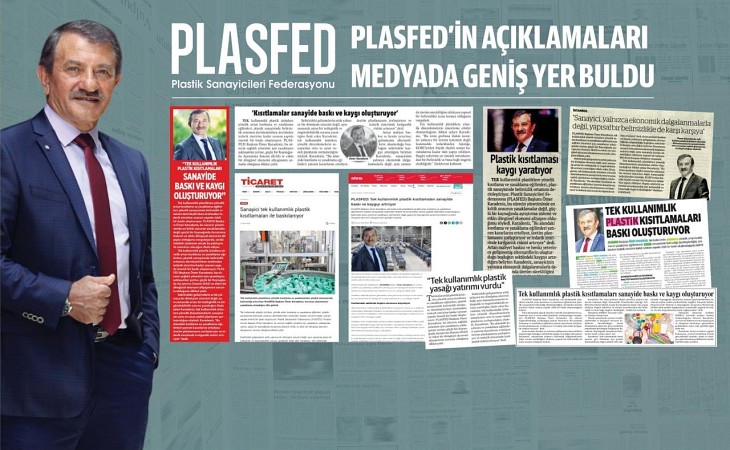
The growing trend of restrictions and bans on single-use plastics is deepening the environment of uncertainty in the plastics industry, while creating serious pressure on the structure ranging from production to the supply chain. PLASFED President Ömer Karadeniz emphasizes that the most critical element in managing this process is not prohibitions, but a strong Source Separation System and an effective circular economy infrastructure, stating that a sustainable solution will only be possible with this approach.
The growing trend of restrictions and bans on single-use plastic products is deepening the environment of uncertainty in the plastics industry, while creating significant pressure on the structure ranging from production to the supply chain. Ömer Karadeniz, Chairman of the Board of the Plastics Industrialists Federation (PLASFED), pointed out that for the healthy management of this process, instead of restrictive approaches, a strong Source Separation System (SSS) and an effective circular economy infrastructure are mandatory.
Stating that the developments in the sector no longer represent just a transformation process, but also create increasing anxiety and a problem of predictability, Karadeniz said that regulations on single-use products are making the medium and long-term plans of industrialists difficult. Karadeniz said, “The trends of restrictions and bans in this field are delaying investment decisions, complicating production planning, and increasing the risk of fragility in the supply chain.”
“THE LEVEL OF ANXIETY IN THE SECTOR IS INCREASING”
Stating that the increasing cost pressure and the gap created by insufficiently developed alternatives are increasing anxiety in the sector, Karadeniz emphasized that industrialists are faced not only with economic fluctuations but also with a structural uncertainty that affects production continuity.
Pointing out that regulations on single-use plastics create chain effects, Karadeniz said, “Decisions regarding this product group affect not only one production item; they affect the entire structure from raw material supply to logistics, from SMEs to large-scale industrial organizations. Today, one of the most important problems of the sector is uncertainty and the lack of predictability associated with it.”
“TRANSFORMATION CREATES COST PRESSURE ON SMES”
Karadeniz stated that the plastics industry is in a structure that supports environmental sustainability and circular economy goals, but this transformation must be managed with a realistic and planned transition model.
Emphasizing the critical importance of the Source Separation System at this point, Karadeniz said, “The fundamental issue in waste management is obtaining the necessary raw material for recycling correctly. No model established without strengthening the Source Separation System is sustainable. Furthermore, the effective implementation of the Deposit Return System and the Source Separation System together will contribute to closing the raw material deficit to some extent.”
Stating that the transformation process creates cost pressure, especially on SMEs, Karadeniz noted that policies should be shaped by considering the realities of the sector and production balances, evaluating that, “Environmental goals can only become permanent with policies that do not exclude production, but rather strengthen the circular economy.”
At this point, Karadeniz also calls on decision-makers, stating that environmental goals can only be sustained with planned policies that have strengthened infrastructure and are compatible with production realities.
This content has been translated using artificial intelligence technology.