




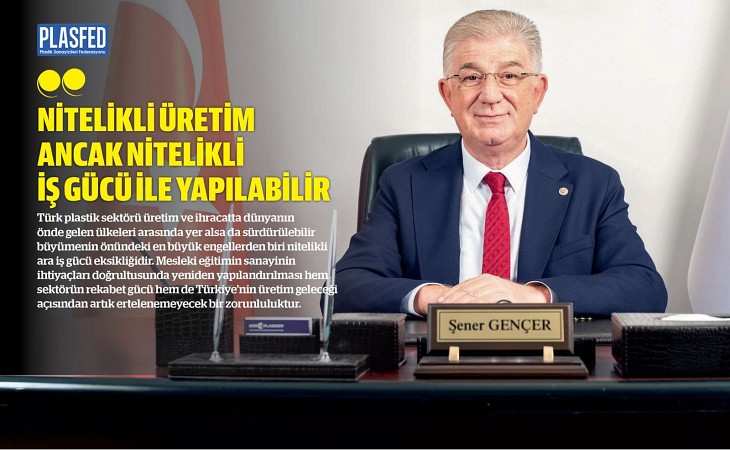
QUALIFIED PRODUCTION CAN ONLY BE ACHIEVED WITH
A QUALIFIED WORKFORCE
Şener GENÇER
Aegean Plastics Manufacturers Association (EGEPLASDER)
Chairman of the Board
Although the Turkish plastics industry ranks among the world's leading countries in production and exports, one of the biggest obstacles to sustainable growth is the shortage of skilled intermediate workforce. Restructuring vocational education in line with the needs of industry has become an urgent necessity both for the sector's competitive power and Turkey's manufacturing future.
We state this many times with pride. As the Turkish plastics industry, we possess the sixth largest manufacturing power in the world and the second largest in Europe. We are the top-exporting sub-sector within "Chemicals and Chemical Products," which is Turkey's second-highest exporting sector.
However, we must not forget that among the structural problems of our sector—which I have been a part of for over half a century—are the training and employment of a skilled intermediate workforce.
To draw attention to this issue, one of the regular meetings of the Board of Directors of the Aegean Plastics Manufacturers Association (EGEPLASDER) was held at the Bornova Mazhar Zorlu Plastics Industry Vocational High School.
Without a doubt, our goal was to highlight this deficiency in Izmir, which is one of Turkey's most important production centers for the plastics and packaging sectors. During the visit, hosted by our School Principal Zülküf Yıldız, we evaluated the educational curriculum of the 28-year-old high school and the demands of our industrialists.
A WORKFORCE CAPABLE OF OPERATING MOLDS IS NEEDED
We bring our colleagues together at every opportunity with the young people who aim to join our sector as an intermediate workforce. We express in various settings that we are ready to employ all young people studying polymers and plastics, both in high school and university.
However, solving Turkey's vocational education problem requires an effort far beyond our scale. Unfortunately, there is no vocational education policy in our country coordinated with the business world. Putting aside the wrongness of having hundreds of thousands of young unemployed engineers, we also do not have firms to employ them. However, we desperately need young workers who can set up molds, perform injection molding, blow molding, and process raw materials. The wages we pay these young people are even higher than the salaries paid to engineers. We practically watch over our trained youth with utmost care so they do not go elsewhere.
THE VISIONARY PERSPECTIVE OF BROTHER MAZHAR
At this point, we must remember with mercy and gratitude Mazhar Zorlu, the elder and doyen of our sector, who passed away in 2004. Being the work of Brother Mazhar, the most visionary businessperson of the Turkish plastics industry, our high school has been contributing to meeting the intermediate workforce demand of our Turkish plastics sector since 1998.
Raising the education quality of our universities and vocational schools stands before us practically as a national issue. To be frank, we need to discuss why our republic, which has left 103 years behind, still cannot solve this problem. We must not forget that vocational education assumes a vital function in the success level achieved today by Germany, where practically not a stone was left upon a stone in the 1940s.
As of today, there are 208 state and foundation universities in our country. These institutions graduate hundreds of thousands of young people every year. Even in countries with highly developed industries like Germany, there are not this many universities and this many graduates.
THERE IS NO NEED FOR THIS MANY ENGINEERS
Just as we do not need this many engineers, young people with engineering diplomas working as cashiers in supermarkets is a dramatic waste of human resources. Getting their diploma claiming they finished university, they stand before us and start asking the question, ‘When am I going to become a manager?’
While hundreds of thousands of young people left out in the open cannot find jobs, we are looking for an intermediate workforce. Today, the common characteristics of countries cited as examples for their economies and levels of development are the importance they attach to the intermediate workforce and their high-standard vocational education systems. Therefore, as plastics industrialists, we protect the young people studying both at the Mazhar Zorlu Plastics Vocational High School and the Ege University Ege Vocational School Polymer Technologies Department like the apple of our eye.
Because we know very well that qualified production can only be achieved with a qualified workforce.
This content has been translated using artificial intelligence technology.