



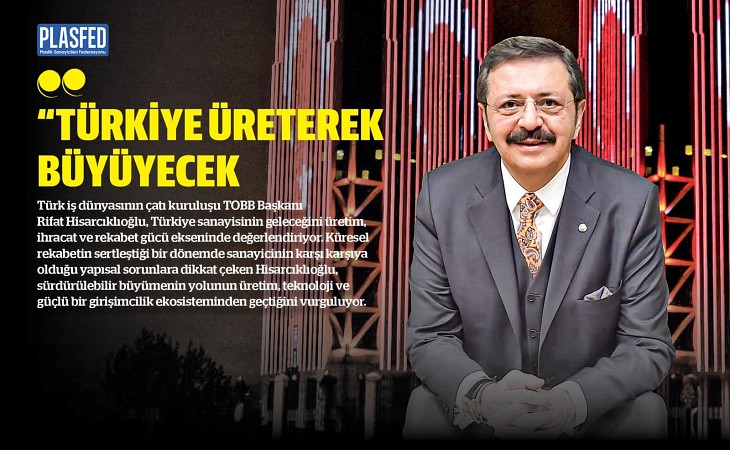
The President of the Union of Chambers and Commodity Exchanges of Turkey (TOBB), the umbrella organization of the Turkish business world, Rifat Hisarcıklıoğlu, evaluates the future of Turkish industry through the lens of production, exports, and competitiveness. Drawing attention to the structural problems faced by industrialists in a period of intensified global competition, Hisarcıklıoğlu emphasizes that the path to sustainable growth lies in production, technology, and a strong entrepreneurship ecosystem.
Turkish industry is entering a new era where global competition is intensifying and green and digital transformations are gaining momentum. The transition to high technology in production, increasing value-added in exports, and localization targets in critical areas are at the center of Turkey's industrial agenda. The President of the Union of Chambers and Commodity Exchanges of Turkey (TOBB), Rifat Hisarcıklıoğlu, evaluated Turkey's industrial vision, the fundamental problems faced by industrialists, and the strategic role of the plastics sector in the economy. Pointing to Turkey's strong production infrastructure, Hisarcıklıoğlu says, "Turkey is the country with the highest export volume and industrial production capacity in this geography." In our interview, where we discussed topics such as global competition, access to finance, green transformation, and the future of the plastics sector, Hisarcıklıoğlu emphasizes that "growth based on production, employment, and exports must be supported."
We talked to Rifat Hisarcıklıoğlu about everything we were curious about regarding Turkish industry...
How do you define Turkey’s industrial vision for the next five years?
Turkey’s 2030 Industry and Technology Strategy focuses on high-tech production, localization, and digital and green transformation. With the National Technology Initiative, it aims to reduce foreign dependency in critical areas (such as artificial intelligence, semiconductors, nuclear, and robotics) and strengthen production through Organized Industrial Zones. By 2030, the target is to increase the share of the manufacturing industry in national income from 21 percent to 23 percent, its share in global manufacturing value-added from 1.33 percent to 1.65 percent, manufacturing industry exports from 247 billion dollars to 400 billion dollars, and the ratio of R&D expenditures to national income from 1.42 percent to 2.20 percent.
Where are the plastics and chemical sectors positioned in this vision?
Chemical and plastic products are important suppliers for other industries, including construction, agriculture, durable consumer goods, automotive, and electronics. In terms of volume, it ranks after Germany among EU countries. With its growing economy, strong business environment supported by a dynamic and large domestic market, advanced infrastructure, qualified and competitive workforce, and investor-friendly legislation, Turkey is an attractive investment, export, and production destination in the chemical and plastics sector. Furthermore, our country offers many opportunities to domestic and foreign investors in petrochemical products.
What do you think are the three most urgent structural problems for industrialists today? What role does TOBB play in these areas?
High input costs, difficulties in accessing finance, and shrinking profit margins are the most prominent among many other problems experienced in the industry. The increase in input costs stems mainly from energy, employment, and the tax system. More widespread and effective implementation of fiscal discipline and spending reforms in the public sector will reduce the budget deficit and, consequently, allow for a reduction in tax burdens. To facilitate access to finance, restrictions on cash loan growth should be lifted. The resource structure of banks should be strengthened by encouraging TL deposits. The Credit Guarantee Fund and commercial receivables insurance mechanisms should be utilized more widely. We continuously communicate our demands and suggestions regarding these issues to the relevant ministries.
In a period where global competition is so fierce, what are the strongest and weakest points of the Turkish industry?
One of our greatest strengths is having an entrepreneurial and dynamic middle class. Our businesspeople also possess the capacity and ability to adapt to change and new conditions, and to learn quickly. The diversity of our industry's production infrastructure is another of our strong points. We are an important production center on a regional and global scale in sectors such as textiles, automotive, defense industry, white goods, chemicals, and machinery. The high share of the manufacturing industry in exports demonstrates our competitiveness. Our proximity to the European market is an advantage in terms of global supply chains. Leading the weak points are low R&D expenditures and the low share of high-tech product exports. This limits our global competitiveness. Exports in the industrial sector are dominated by medium-tech products. The mismatch between the education system in Turkey and the workforce profile needed by the industrial sector is also a significant problem. This mismatch reduces productivity in production and weakens the competitiveness of businesses.
The plastics industry is a primary input for many sectors, from automotive to defense, and from packaging to health. Do you think the plastics sector is viewed as a sufficiently strategic sector in Turkey?
Chemical products, which have a very wide range of applications, have entered many points of our lives. They are an indispensable component of industrial production, trade, and consumption chains. We have a vibrant domestic market parallel to our growing economy, and demand here exceeds production. Therefore, there is a need for more production and investment in the chemical and plastics sectors. We rank second in Europe and sixth in the world in plastic production. We are fourth in Europe in packaging production and fifth in paint production. Since about one-fifth of the sector's production is exported, it also has an important place in terms of the country's foreign exchange earnings. The plastics sector is seen as one of the most important actors in the Turkish economy with its stable growth, total production exceeding 10 million tons, turnover of around 40 billion dollars, and exports exceeding 7 billion dollars.
How do you evaluate the fact that the plastics sector is sometimes targeted through environmental debates?
All waste left in nature harms the environment. The place for waste is not nature, but recycling centers. To prevent waste of resources, waste must be recycled and reused. Environmentally friendly plastic products and recycling projects are gaining more and more importance in the sector. Plastic is the most environmentally friendly material in recycling, and it is possible to recycle it easily. Here, it is of great importance to influence public opinion with correct information. It is the people who leave waste in nature who pollute the environment. At this point, it is necessary to create environmental awareness in society and to change the habit of "use-and-toss" to "use-recycle-use." The plastics sector is one of the most advantageous sectors in terms of recycling due to its low carbon footprint. What needs to be done is to collect it in the healthiest way at the lowest cost after use and to recycle it at the lowest cost. It is necessary to create recycling awareness in the public and facilitate recycling. In this way, we advocate that the Recovery Contribution Share (GEKAP) paid by our producers should be transferred to the companies' waste management, recycling, and zero-waste projects, which would directly trigger the process. This will also feed the recycling sector on a raw material basis and save us from the pressure of imported raw materials and being dependent on abroad.
What steps should be taken in the short term for the difficulties SMEs and manufacturing industrialists face in accessing finance?
Both the restrictions on loan growth and high interest rates are shackles on the feet of our SMEs, in particular. To overcome these difficulties, we must apply positive discrimination to SMEs. We should take them outside the monthly loan growth limit. We should also keep commercial credit cards outside of this limitation. We must prevent the current credit limits from shrinking in real terms. In our traditional markets abroad, competition from China has become more severe than ever. Therefore, we must definitely introduce new and proactive support for exports. We should increase the export rediscount credit volume to a level equivalent to three months of exports. The Central Bank's foreign exchange conversion support is neither sufficient nor are its conditions very heavy. Less than one-fifth of our members who export can access this. This application should be simplified, and both its amount and duration should be increased.
Are regulations like the Green Deal, KKDIK (Turkey's REACH), and similar ones a risk or an opportunity for industrialists? How ready is Turkey for this process?
Global trade is undergoing a significant transformation with standards and regulations aimed at reducing carbon footprints. This situation harbors opportunities as well as risks. If we prepare correctly, it will increase the competitiveness of our economy and contribute to the sustainable growth of our exports. Green transformation is not just an environmental policy but also a growth strategy. Within the scope of the negotiations for the modernization of the Customs Union we have with the EU, we must develop strategies compatible with environmentally sensitive production and trade goals. Domestically, we must work to encourage low-carbon production models and increase energy efficiency. The acceleration of work on the legislative infrastructure for financing green transformation, taxonomy, measurement, verification and reporting, as well as risk management and data production, is important for our banks to provide credit for green transformation to our industry, especially our SMEs, and for international financial resources for green transformation to be directed to the Turkish economy.
What do you think is the most fundamental feature that distinguishes TOBB from other professional organizations? How can sectoral federations and associations create a stronger synergy under the umbrella of TOBB?
As TOBB, the umbrella organization of the Turkish business world, we are at the service of our millions of members with our Chambers-Exchanges and Sector Councils in 81 provinces and 160 districts. The entirety of our business world, both geographically and sectorally, is represented here. Thanks to our wide network in the country, we follow the problems regardless of scale and develop solutions for these problems. Later, we follow up on the solution to these problems through public-private sector consultation mechanisms. We work together with sectoral federations and associations in the sector councils under the TOBB umbrella and develop common sense. We carry out work on the reform areas needed by the business world. We work with our public institutions to implement these reforms.
How do you evaluate the influence of non-governmental organizations in shaping economic and industrial policies in Turkey? Do you think the power of NGOs is sufficient?
The fundamental source of long-term growth is technological progress and productivity increases. Therefore, there must be an economic environment that encourages productive economic activities. Industrial policies to be designed in this context are an important tool for the country's development and progress and are the driving force of industrialization. The correct design and implementation of industrial policies is the duty and responsibility of all of us, both public and private. There are dialogue mechanisms established in the Turkish Grand National Assembly (TBMM) and Ministries on this subject. As TOBB and sector councils, we actively participate in these and convey the problems and demands of our business world. This is our duty. We are not the executive body. The executive authority rests with the political will that has received the mandate from the Constitution and our nation on this matter.
What should be done to increase the interest of young entrepreneurs in the industry?
An entrepreneur-friendly ecosystem needs to be established, and a sustainable support system needs to be implemented. Tax and fiscal policy tools should be used to support innovative entrepreneurship. To develop an entrepreneurial culture, entrepreneurship training should be widespread in schools and universities, and a consultancy system and special incubation centers for entrepreneurs should be developed. Access to finance for entrepreneurs should be facilitated. It should be made attractive to use non-bank financing, venture capital, angel investors, and crowd-funding tools. Administrative and financial legislative regulations create more burden on small businesses. A regulatory impact analysis should be conducted to eliminate factors that hinder the development of businesses. Exemptions should be provided, transition periods should be determined, and legislation should be simplified.
Can we say that "producing in Turkey still holds a promise for the future"?
In the last 25 years, Turkey and our private sector have moved beyond being a local actor. In many industrial sectors, in tourism, in international contracting, and in road transport, we have become among the leaders not only in this geography but in the world. We have investments, construction projects, machine parks, and partnerships throughout our surrounding geography. It is in our hands to further develop and grow these. Turkey is the country with the highest export volume and industrial production capacity in this geography. The process we are going through contains various challenges, but we believe that we will overcome these as well. We have a growing economy, a resilient and dynamic real sector. We also find the determined stance of the economic management, their emphasis on stability, and their commitment to rational policies promising for the future. Growth based on production, employment, and exports should be supported, and reforms that will improve the business and investment environment should be continued.
How do you evaluate the contribution of sectoral federations like PLASFED to the Turkish industry?
I find the work of PLASFED, which acts with the vision of providing synergy by bringing our industry together in the plastics sector, very valuable for our country and our sector. I follow with appreciation that it fulfills this great responsibility it has undertaken with its activities that increase every year and its developed corporate capacity. With its result-oriented work, PLASFED does not settle for just identifying and voicing problems, but proposes permanent solutions to them and ensures their implementation. As the President of TOBB, I take pride in the successful work of PLASFED, which represents the stakeholders that make up the plastics industry in the best way and is also a member of our TOBB Turkey Plastics, Rubber, and Composite Industry Council. I heartily congratulate the Chairman of the Board of Directors, Mr. Ömer Karadeniz, the members of the Board of Directors, and its employees.
"Turkey gets stronger as women produce"
On the occasion of March 8, I celebrate all women's International Women's Day. We want women to take a more active role in social life and business life. Women taking a greater part in production, industry, entrepreneurship, and decision-making mechanisms will increase our country's competitiveness and social welfare. Turkey has made significant progress in women's entrepreneurship. In the last 25 years, the ratio of women among total entrepreneurs has doubled. Our TOBB Women Entrepreneurs Council, which has become Turkey's largest entrepreneur network, has a large share in this. Our council has increased the effectiveness of women in economic life with the projects they have carried out. With nearly 7 thousand entrepreneur women members, it has become a role model, a guide, and a source of inspiration in encouraging and developing entrepreneurship. I am proud of all our women who have achieved success in business, science, education, culture, art, and sports life.
This content has been translated using artificial intelligence technology.