




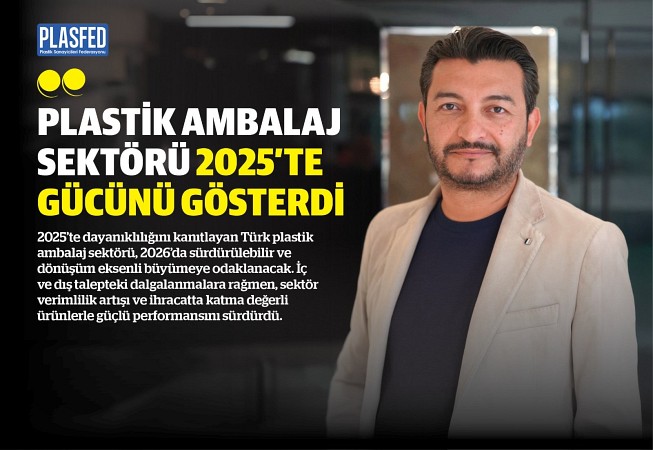
The Turkish plastic packaging sector, which proved its resilience in 2025, will focus on sustainable and transformation-oriented growth in 2026. Despite fluctuations in domestic and foreign demand, the sector maintained its strong performance with increased efficiency and value-added products in exports.
Kağan YEŞİL
Bursa Plastic and Packaging Industrialists Association (BURPAS)
Chairman of the Board
The year 2025, which we are preparing to leave behind, has been a challenging but instructive year for both the Turkish economy and the plastic packaging sector. We are leaving behind a period shaped by uncertainties in the global economy, fluctuations in energy prices, geopolitical tensions, and financial tightening policies in the domestic market. However, despite all these difficulties, the Turkish plastic packaging sector once again proved its resilience with its production capability, export strength, and agile structure.
Year of balancing and selective growth
The year 2025 can be characterized as a “year of balancing” for the Turkish economy. The downward trend in inflation, strengthening of fiscal discipline, and gradual decrease in the foreign trade deficit gave important signals towards stability in the overall outlook. However, the contraction in domestic demand periodically suppressed industrial production and thus packaging consumption. In contrast, for export-oriented companies, 2025 was a period where new market searches and digital transformation investments aimed at increasing efficiency accelerated. Turkey's strong industrial base in its production infrastructure offered significant advantages to Turkish manufacturers, especially in the supply chain restructurings experienced in the European market.
Sustainable growth, increasing efficiency
The plastic packaging sector recorded a real growth of approximately 4 percent in 2025, performing above the general industry average. Thanks to its structure serving strategic sectors such as food, hygiene, cosmetics, and chemistry, production capacity was largely maintained despite fluctuations in domestic demand. The most significant trend of the year was a noticeable increase in the use of recycled raw materials and an acceleration in R&D investments for sustainable packaging solutions. Field analyses conducted by BURPAS show that a large portion of our member companies systematically implemented carbon footprint reduction and environmental reporting processes in 2025. Furthermore, investments in digital production tracking systems, energy efficiency projects, and environmentally friendly packaging designs strengthened the sector's competitiveness both in the domestic and international markets. Especially in preparation for the requirements brought by the European Green Deal, our companies made significant progress in integrating sustainability criteria into their supply chains.
Diversification and increase in added value in exports
In 2025, although quantitative growth in plastic packaging exports remained limited, an increase in unit prices was observed. This indicates that Turkish plastic packaging manufacturers are shifting towards value-added products and that branding awareness has strengthened. Turkish packaging manufacturers have become preferred suppliers in markets such as the Middle East, North Africa, and Latin America, particularly the European Union, due to their quality and delivery reliability. As of 2025, Turkey’s plastic packaging exports increased by nearly 5 percent, with approximately one-third of domestic production being directed to exports. Consequently, despite all fluctuations, 2025 once again demonstrated how resilient the Turkish plastic packaging industry is. In 2026, we will move beyond resilience into a period of smart growth and sustainable transformation. As BURPAS, we will continue to work with our sector stakeholders to make a production approach that adds value to both the environment and the economy a permanent reality.
This content has been translated using artificial intelligence technology.