




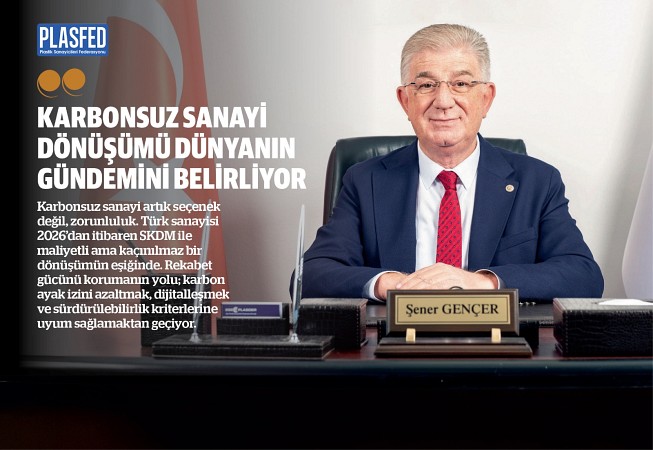
ŞENER GENÇER
Aegean Plastic Industrialists Association (EGEPLASDER)
Chairman of the Board
Carbon-free industry is no longer an option but a necessity. Turkish industry is on the brink of a costly but unavoidable transformation with the Border Carbon Regulation Mechanism (SKDM) coming into effect in 2026. The way to protect competitive power lies in reducing carbon footprints, digitalization, and complying with sustainability criteria.
As of January 1, 2026, Turkish industry, especially sectors with high energy consumption and emissions, is expecting a completely different era.
Implemented as part of the European Union's "Fit for 55" package, the Border Carbon Regulation Mechanism (SKDM) is one of the key tools serving the EU's goal of becoming the first carbon-neutral continent by 2050. With the SKDM, the EU aims to prevent carbon leakage, enhance the effectiveness of the Emission Trading System, and keep global temperature rise below two degrees.
THOSE AT THE EDGE OF THE GUN
I can hear my colleagues asking, "What will this cost us?" The SKDM, which entered into force on May 17, 2023, includes reporting and data collection obligations beginning with a transition period starting in October 2023. The actual phase will begin on January 1, 2026. From this date, financial obligations based on carbon content will come into effect.
Although the EU cannot impose direct taxes on third countries, it is enforcing a mandatory Carbon Certificate requirement for importers within the Union. Initially, the iron-steel, cement, aluminum, fertilizer, electricity, and hydrogen sectors will be included, followed by the oil, paper, glass, ceramics, plastic, and brick sectors in the later process.
A challenging, costly, but unavoidable transformation awaits the Turkish economy. Because combating climate change is now at the center of industrial policies, not just eco-friendly rhetoric. The crucial question we all need to answer is:
As global industry rapidly moves towards carbon neutrality, how prepared is Turkish industry for this transformation?
NOT AN OPTION, BUT A NECESSITY
Decarbonization is not just an issue of environmental sensitivity or social responsibility; it is directly a matter of competitiveness. Companies that cannot calculate their carbon footprints, digitalize their production, or comply with sustainability criteria will face serious disadvantages, especially in the European market.
The plastic sector is a strategic area for Turkey, with its high production volume and export power. In the last 20 years, we have gained significant momentum, becoming the second-largest producer in Europe and the sixth-largest in the world. However, this growth has also brought high carbon emissions, waste management issues, and energy efficiency gaps.
SHOWING THE PATH TO COMPLIANCE
As EGEPLASDER, we are taking concrete steps to prepare our members by anticipating the effects of this transformation on our industry. We strive to enhance our members' competencies through company visits, information meetings, and collaboration with Celal Bayar University TEKNOKENT in R&D.
One of our most important projects, the UR-GE project, focuses not only on increasing exports but also on carbon footprint calculations, sustainable production consultancy, digital infrastructure transformation, and compliance with international environmental regulations. With this clustering model involving 17 companies based in Izmir, we aim for our members to achieve collective awareness and adaptation to the process at lower costs. This 75% publicly funded project represents a first in our industry.
LET OUR WASTES BE FURNITURE
Sustainability encompasses not only energy but also waste management. With this understanding, our "Let Our Wastes Be Furniture" project aims to transform plastic waste into urban furniture. Through this project, which we share with Izmir Metropolitan Municipality, industrial waste is not only disposed of but also converted into added value. This initiative serves as an exemplary model in terms of both environmental and social responsibility.
NOT TO MISS THE FUTURE...
Global industry is rapidly advancing towards decarbonization. This process will directly shape our production models, export standards, and investment priorities. Turkey's plastic sector should not fall behind in this race with its strong production infrastructure and export potential.
However, goodwill and awareness alone are insufficient for transformation. Concrete steps, proper guidance, financial support, and organizational solidarity are needed.
As EGEPLASDER, we do not just guide our members; we are developing, implementing, and sharing actionable models that pave the way for transformation.
Translated by Artificial Intelligence