




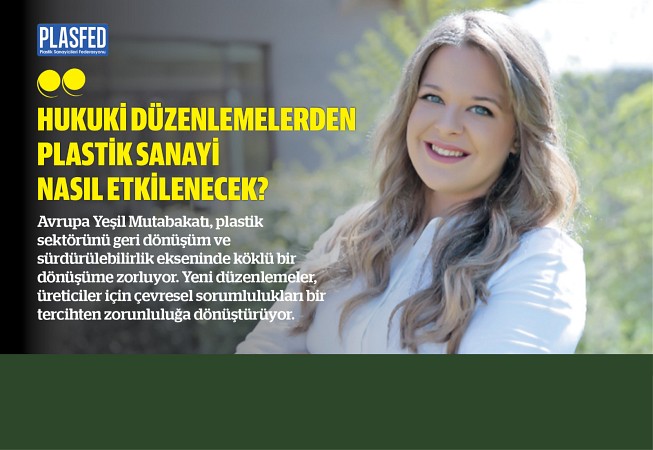
The European Green Deal is forcing a radical shift in the plastic sector towards recycling and sustainability. The new regulations are turning environmental responsibilities for manufacturers from an option into a necessity. The Green Deal confronts plastic producers with environmental responsibilities. Sustainability is now the most critical measure of competition!
Sustainability, Energy and Climate Law Expert
The EU Green Deal, approved by the European Commission in 2020, has brought new regulations that will affect both the countries within the European Economic Area and the third countries with which the EU conducts trade. The new regulations brought by the Green Deal significantly impact various sectors towards sustainability goals, with the plastic industry becoming one of the most notable areas of concern.
The Green Deal aims to make Europe a carbon-neutral continent by 2050 while also promoting a circular economy, efficient resource use, and biodiversity protection. Therefore, it can be said that the regulations coming with the Green Deal will have significant impacts across industries, agriculture, transportation, finance, and many other sectors. Additionally, these regulations are not only relevant to the EU’s internal market but also have a close connection with EU foreign trade. Regulations such as the Carbon Border Adjustment Mechanism and the Single-Use Plastics Directive directly affect both producers within the EU and countries that trade with the EU.
NEW REGULATIONS
One of the most attention-grabbing regulations following the Green Deal is the Single-Use Plastics Directive, which came into effect in 2021. This directive imposes significant restrictions on the use of products such as straws, cutlery, plates, and cotton buds, even banning some of these products altogether. A new requirement established by this directive mandates that bottle caps be designed to remain attached to bottles. This implementation, which becomes mandatory in 2024, represents a significant change for plastic product manufacturers. Furthermore, the Directive stipulates that by 2025, all PET bottles must contain at least 25% recycled plastic content, increasing to 30% by 2030. The main goal of these regulations is to boost demand for recycling markets while promoting raw material circularity.
Another important regulation is the Packaging and Packaging Waste Regulation. This regulation requires plastic packaging manufacturers to assess the environmental impact of their products throughout their life cycle and to ensure the recyclability of their products. All these obligations necessitate a significant transformation for plastic producers, not only environmentally but also financially and operationally.
EXTENDED PRODUCER RESPONSIBILITY
The Extended Producer Responsibility (EPR) principle is a parallel application to the “polluter pays” approach found in many different regulations under the Green Deal. Under this extended responsibility, producers are now responsible not only for production but also for post-waste stages. In this context, producers are required to provide financial contributions to waste management, cleaning, and public awareness costs arising from the waste generated from their products.
In other words, with the SUP Directive, Extended Producer Responsibility makes plastic producers directly accountable for the environmental impacts of their products not only during the production stage but also after their use. Producers must now consider how every piece of plastic they release—ranging from packaging to wet wipes, from cigarette filters to fishing nets—will be collected from the streets, sorted, and how this will be communicated to the public.
Considering all of this, it is now possible to say that producers are required not only to cover waste management costs but also to financially contribute to campaigns aimed at enhancing cleaning and environmental awareness. This, of course, means that new items are added to the cost structures of companies operating in the plastic sector. The issue is no longer just about producing quality and inexpensive products; it is also about competing in a process measured by environmental sustainability performance. This scenario creates significant compliance pressure particularly for small and medium-sized producers while compelling large producers to invest in recycling infrastructures.
CARBON BORDER ADJUSTMENT MECHANISM COMING IN 2026
The EU Carbon Border Adjustment Mechanism (CBAM) will fully come into effect by 2026. With this regulation, carbon emission limits that manufacturers in the EU must comply with will also apply to products produced outside the EU but exported to the EU. Otherwise, these products will be taxed according to their carbon content at the border.
Although the CBAM initially is limited to sectors such as cement, iron-steel, aluminum, fertilizers, electricity, and hydrogen, it seems highly likely that plastic and petrochemical products will be included in its scope after 2026. Given that the plastic industry, even if not directly within the CBAM scope, is an indirectly affected sector due to high carbon footprint manufacturing methods. For instance, plastic products made from petrochemical raw materials with high carbon density risk falling into a disadvantaged position in the EU market. Consequently, producers will have to invest not only in the physical quality of their products but also in the environmental sustainability of their production processes.
IS THE GREEN DEAL A RISK OR OPPORTUNITY?
Turkey's production processes in the plastic industry are largely still fossil fuel-based, with recycling rates below the EU average. Moreover, when evaluating the necessary criteria such as life cycle analyses, carbon calculations, and environmental impact statements for compliance with the Green Deal regulations, it is apparent that most companies are not ready for this transformation. However, this situation can be changed positively. The Green Deal does not only pose sanctions for the plastic sector but also presents opportunities. For instance, bioplastics, compostable packaging, and innovative recycling technologies are among the fast-growing markets in the upcoming period. Therefore, EU funds provide significant incentives to companies engaged in sustainable production. The green transformation funds offered by the EU particularly provide serious grant and incentive opportunities for companies investing in R&D, implementing sustainability reporting, and committing to carbon reduction. Companies in Turkey can apply for these funds directly or through framework programs such as Horizon Europe and IPA. In fact, many EU countries are actively looking for partners for projects that can support foreign companies they will integrate into their supply chains to elevate their “environmental compliance” levels.
In summary, companies that adapt to this transformation not only eliminate risks but also could be part of a process that will enhance their competitive power, open new export channels, and strengthen brand value in the long term. Therefore, companies that keep pace with the transformation have the potential to gain an advantage in new markets.
Who is Attorney Ayşe Sırma ÖZBERBER?
She specialized in European Union Law by completing a master’s degree at the Institute of European Union Studies at Marmara University. She works on legal regulations that have come into effect in the fields of sustainability, energy, and climate change, primarily focusing on the European Union Green Deal. Shaping her legal practice around environmental and social responsibility, Özberber is particularly engaged in ESG (Environmental, Social, Governance) consulting.
Having served as a lawyer at PricewaterhouseCoopers for over five years, Özberber has contributed to various studies and conferences in the ESG field there. Currently continuing her freelance legal practice, Özberber is pursuing doctoral studies in sustainability and law at Istanbul Medeniyet University. By closely monitoring legal developments in Turkey, she continuously updates her professional practice to meet the demands of the modern era.
Translated by Artificial Intelligence