


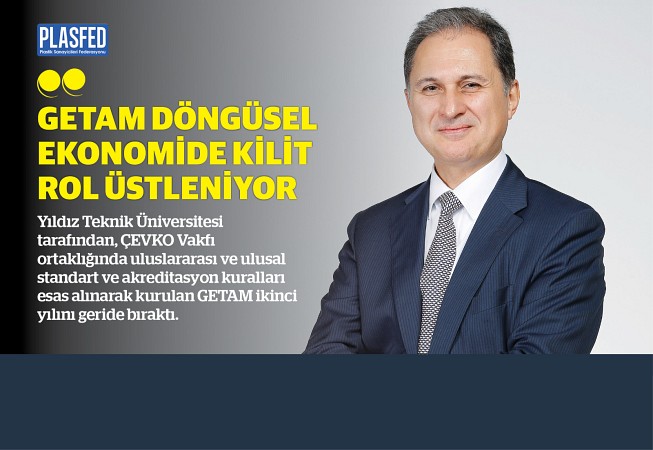
The "Recovery Test and Research Center (GETAM)" established by Yıldız Technical University in partnership with the ÇEVKO Foundation has completed its second year. The center, which brings a new dimension to sustainability-focused Public-Academy-Industry collaborations, provides certifications that producers may need.
The Recovery Test and Research Center (GETAM), established in collaboration with Yıldız Technical University and the ÇEVKO Foundation, fills an important gap in sustainability and circular economy in Turkey, as it completes its second year. The center offers testing and certification services in accordance with international standards, especially responding to producers' needs regarding recyclability and material content.
GETAM provides results within just two to three weeks with its analyses in areas such as the ratio of recycled materials in plastic packaging, biodegradability, and recyclability. These certificates not only provide significant advantages to producers in export processes but also contribute to Turkey's compliance with international regulations such as the European Green Deal.
Mete İmer, the Secretary General of the ÇEVKO Foundation, emphasizes that Turkey has a serious recycling capacity, but a large portion of the waste is sourced through imports. İmer states that domestic waste needs to be effectively collected and integrated into the recycling system and underlines the necessity of reactivating the Extended Producer Responsibility (EPR) system.
Turkey has a serious recycling capacity
According to the data from the Turkish Statistical Institute (TÜİK), in 2022, a total of 48.5 million tons of waste, including imported waste, was recycled at 2,866 waste processing facilities, including metal, plastic, paper, etc. İmer points out that over half of this, more than 24-25 million tons, can be considered imported, stating: "The problem is about our inability to separately collect and evaluate our own waste. A reduction in waste imports could render this recycling capacity dormant. It is extremely important to take measures to separately collect and evaluate our own waste, especially the waste generated after consumption from households. In our country with a large population, if we can collect and evaluate our recyclable waste, which has become a raw material requirement for the industry, we can utilize our recycling capacity in a way that minimizes waste imports."
The ÇEVKO Foundation became a member of RecyClass
The ÇEVKO Foundation has become a member of RecyClass, which provides reliable tracking of the sources of plastic waste through its scientific approach, and offers services for calculating and verifying the recycled content in plastic products. RecyClass is a non-profit, inter-sectoral initiative that brings transparency to the origins of plastic waste and establishes a compliant approach to calculating and tracing recycled plastics in Europe. RecyClass develops innovative sustainability assessment protocols and scientific testing methods for plastic packaging materials, issuing Recyclability Certificates for plastic packaging, Recycling Process Certificates for plastic products, and Recyclable Plastic Traceability Certificates.
Translated by Artificial Intelligence