



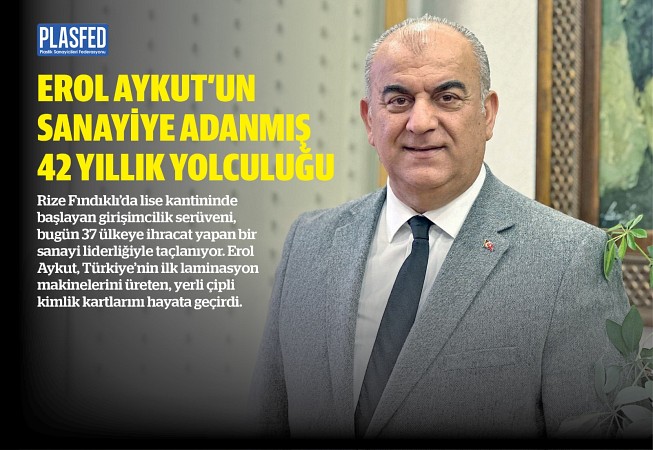
The entrepreneurial journey that began in a high school canteen in Fındıklı, Rize, is crowned today with an industrial leadership exporting to 37 countries. Erol Aykut, who produced Turkey’s first lamination machines and brought local chipped identity cards to life, is an industrialist who has made honesty, sincerity, and respect for labor the fundamental principles of his business. Aykut, who continues to add value to the country’s economy with Eraysan Group and the MAPİ brand he founded, made a strong call in his interview with PLASFED Magazine, stating, “Industrialists should be supported because Turkey’s future lies in production.”
Born in the Fındıklı district of Rize, an entrepreneur who started his business by operating a canteen during his high school years and today exports to 37 countries… Erol Aykut has made his way in Turkey’s industrial and commercial life for over 42 years with his sincerity, honesty, and respect for labor. With the “Eraysan Group” and “MAPİ” brands he founded, he has pioneered many innovations in Turkey, from advanced office systems and lamination machines to local chipped identity cards. He is also the leader of a family company that has spearheaded the development of the plastics sector and successfully institutionalized with its second generation.
Erol Aykut exemplifies a model stance not only with his achievements in business life but also with over 30 years of voluntary work in non-governmental organizations, his support for regional development, and the powerful messages he leaves for young people. The extensive communication network he has built within NGOs and the international forums he has organized create bridges between the business world and the public.
In this interview, we will sincerely listen to Erol Aykut’s personal story, his vision for domestic production and sustainability, the current state of Turkish industry and the plastics sector, his perspective on government incentives, and his efforts in social responsibility. Aykut, who offers important perspectives on Turkey’s future strengthened by production, conveys his faith in his country and his passion for his work in every line.
Let’s start by getting to know you, who is Erol Aykut?
I was born in 1965 in the Fındıklı district of Rize. I am married and have two children, one daughter and one son. My daughter is a kindergarten teacher and is married; I also have a grandchild. My son operates in the e-commerce sector. He successfully runs his own venture called “Ofisma.com” within the group. I completed my primary, secondary, and commercial high school education in my hometown. My education continued; I completed my economics degree externally. Later, I pursued bachelor’s and master’s degrees in foreign trade and political science. I am still learning in the field of foreign trade. I even have a student card, which I use for public transport (laughs). Education is an never-ending process for me.
How did your business life begin?
I started my business life by operating a canteen during my high school years. I grew up in a challenging but warm region. I always reflected the sincere and hardworking nature of the Black Sea people in my work. My family, cultural values, wife, and children have always been my biggest supporters. When I married my wife, I made a request to her: “Let’s raise our children with a mother’s love.” She made that sacrifice. Today, the strong personalities of our children are rooted in that maternal care and love.
So, when and how was Eraysan founded?
The structure we established as a sole proprietorship in 1984 was incorporated in 1986 as Eraysan Import Export Manufacturing Plastic Industry and Trade Limited Company. The name “Eraysan” comes from Erol AYKUT Industry. We started with my older brother; he took on the more technical aspects, and I handled the management. Then we also brought in our brother-in-law, my sister’s husband, as a partner. We are four siblings and have always progressed with family unity and trust. We moved forward with a common pool system, allowing everyone to work in their area of expertise.
Could you tell us a bit about the products and brands that define you?
We started with lamination systems. We are the first company to produce lamination machines in Turkey. We sold thousands of machines to all civil registration offices. Our signature is on the widespread use of many identity and document lamination systems used today. In the 1990s, we initiated the branding process and created the MAPİ brand. MAPİ means "I did it" in Laz language. Today, MAPİ is a leader in the sector with 4,500 product varieties in 11 main categories, from lamination products to binding machines and office stationery equipment. Together with sub-brands, we have created significant brand awareness.
How was the MAPİ brand born?
MAPİ is a brand that reflects both our regional origins and our labor-based production philosophy. It means "I did it" in Laz. When creating our brand, we based it on our respect for our region and the value we place on labor. Today, with the MAPİ brand, we supply products to many institutions and organizations in Turkey and abroad.
How did you bring your company to its current position?
We have always kept quality, customer satisfaction, after-sales service, price stability, and sustainability together. We expanded abroad, imported from South Korea and China, and produced our own machines. Throughout these processes, we acted with a vision. Today, we export to 37 countries. We also grew abroad with the same sincere, trust-based relationships.
So, how does your group structure operate currently?
Eraysan A.Ş. is our main company. In addition, NOSİ Foreign Trade, E-Medya Advertising, NOSİKA Office Systems, MAPİ Card (smart plastic card production), NBA, and Ofisma (e-commerce companies) are other companies in our group. Each partner takes on tasks in categories suitable for their competencies. The second generation is also on the field. Each manages their own business and budget. They are not tied to a common pool. Thus, a healthy competitive environment is created, not rivalry.
Could you tell us about your identity card production process, which is known to the public through MAPİ Card company?
We are the only company that produces the Republic of Turkey’s chipped identity cards domestically and nationally. We carried out this project in collaboration with TÜBİTAK, the Ministry of Interior, and the Mint. We have a Visa–MasterCard–EMV certified facility with a production capacity of 110 million units. We also produce cards for over 30 banks, transportation cards, and identity cards for many public institutions.
What is the scale of this investment?
Our MAPİ Card production facility was established with an investment exceeding 30 million euros. We worked for two and a half years to obtain international accreditations. Today, with this facility, we have saved Turkey approximately 1.5 billion euros. The government’s turn towards domestic production has created significant added value in this sense.
What do you think is the main difference that sets you apart from others?
Honesty, sincerity, dedication, and respect for labor… We do our work genuinely and wholeheartedly. Our relationship with customers, employees, and the state always continues with the same trust-based structure. Even when imitated or challenged, we did not compromise our principles. This has been the core value that sustained us for 42 years.
Finally, looking back after all these years, what do you see?
A journey that started from scratch, but a very full one. Fortunately, we built a structure that grew with family unity, vision, and honesty. Now the second generation is taking it further. We are adding value to our country with domestic production. This pride is enough for us.
How do you assess the current situation in the sector?
We sowed the right seeds in the sector, and we harvested the right crops. Due to competitive conditions, business may decrease or increase from time to time, but we continue our trade without straying from ethical values. This is our fundamental principle.
How did you enter the plastics sector?
Our plastics side began with the MAPİ KART brand within Eraysan Company. Initially, we produced products like loyalty and discount cards, and university ID cards. Over time, we produced over 100 million cards. Later, we transformed MAPİ KART into a separate company. Today, we have significant investments in smart card production.
Producing smart cards is not an ordinary business, is it?
Absolutely not. This business requires serious technology. You must work in compliance with EMV certifications from institutions like Visa and Mastercard. Our facility is monitored with 496 cameras. Entry-exits, authorization system, and employee security controls are at a high level. Random production cannot be done here. This is a level that should not be confused with illicit production.
Does MAPİ KART operate only in Turkey?
No. Today, we also produce identity cards for many countries. This facility no longer belongs only to the AYKUT family; it has become a national asset. We have become a recognized and known center by the state.
“NGOs ARE POOLS OF VOLUNTARY SERVICE”
We know that you are very active in non-governmental organizations. How did you get started in these areas? I have been actively involved in NGOs as a volunteer for about 25-30 years. I am the founding general chairman of the Turkey Rize Bureaucrats and Business People Association (RİBİAD), established in 2014. I am also the founder of TÜMBİFED, the superior federation of this association. Currently, I am the Vice President of TSTK (Confederation of All Non-Governmental Organizations) at the confederation level.
What is the purpose of these NGOs?
For the first time in Turkey, we established a structure that brings together bureaucrats and business people. We have a structure that includes over 230 professors and focuses on academic and social studies. We are not just a hometown association; we contribute to regions with scientific and sustainable projects.
Have these volunteer efforts contributed to your business life?
Of course. My life priorities are clear: first family, then business, then volunteer services. The relationships I’ve built in NGOs also create synergy in the business world. For example, an NGO member who needs office supplies chooses us. When I need something, I also look to this network first. This mutual cooperation directly contributes to the economy and companies.
Do you think everyone in the business world should be involved in an NGO?
Absolutely yes. Turkey is very far behind in this regard. NGOs are pools of voluntary service. It is very valuable for the country and society that business people participate in these structures with a sense of social responsibility. Touching people, projects, and regions, and providing lasting contributions should also be the responsibility of the business world.
“INDUSTRIALISTS SHOULD BE GRANTED GREEN PASSPORTS”
You have been in the business world for 42 years. What kind of change do you think Turkish industry has experienced during this long journey? Turkish industry, especially in the years I started working, was extremely open to innovation and technology. In those days, everyone who produced something earned money. Those who brought something new to the market earned much more. However, as years passed, we transitioned from the information age to the technology age, and then to periods of human-centered and heart-indexed trade. But I have always seen this: industrialists are always unhappy. It was like that in the past, and it is now. Because the state’s view of industrialists has never been one of crowning them. Yet, this country needs people who produce.
So what do you say should be done for industrialists?
Industrialists should be supported. For example, green passports should be given directly to industrialists. The person who produces and provides employment is the one who sustains the country. Years ago, I invested in plastic cards that no one produced in Turkey. I manufactured machines and distributed them to my dealers in every province. Everyone benefited. As they earned, I grew too. This was a win-win system.
You attach great importance to the issue of production; can you give an example?
Certainly. At one time, I was importing spirals from Hong Kong. Then I decided to produce these products in Turkey. I invested in machinery, and now I export to 37 countries. Imagine, I produce a product I used to import, both in Turkey and sell it worldwide. This way, I cut down on imports and bring foreign currency into the country.
Do you have any criticisms regarding the government’s incentive system?
Of course, there are. There’s constant talk of incentive packages, but they don’t reach the real industrialists. The opportunity is gone by the time paperwork is prepared. People who want to invest need to access financing. What investment can be made with 50-60 percent interest? Low-interest funds should be provided to real producers. There should be direct support for items like machinery, raw materials, personnel, energy, and taxes. China did this. That’s why it grew so much in production.
So, you are saying that the government should support production that not only increases exports but also reduces imports?
Absolutely. If a product comes from abroad and you can produce it here, you are curbing imports. This also contributes to the country’s economy. We once produced bank cards that were not manufactured in Turkey. Today, millions of those products remain in Turkey. This is a significant contribution.
It is said that small and medium-sized enterprises (SMEs) have been experiencing great difficulties recently. How do you see this picture?
That’s right, SMEs are in serious trouble. 58 percent of the top 500 industrial enterprises are in decline compared to last year. Let alone making a profit, there are many companies operating at a loss. These issues are also raised in the Industry Chamber council meetings. Labor problems, access to finance, bureaucracy—all of these hinder industrialists.
Finally, what advice would you give to young people?
I would like young people to work hard, be inquisitive, and productive. They should use technology well, but also not break family ties. Acquire knowledge, but do not lose human affection. Success is possible not only academically but also through character.
What are your views on PLASFED’s work?
The Plastics Industrialists Federation (PLASFED) is a successful organization that unites the sector under one roof. Chairman Ömer Karadeniz’s vision and inclusive approach are very valuable. Without his leadership, PLASFED would not shine as brightly. In NGOs, success is difficult without love, effort, and vision. Chairman Ömer, with his educated, social, and journalistic identity, does this job with passion. He uses social media well, which is very important for communication and visibility. Chairman Ömer says “We,” not “I.” This strengthens the team spirit. Without this spirit, one cannot be a good NGO chairman. PLASFED’s work is successful and very beneficial for the sector…
How does the plastics sector differentiate itself from other sectors?
Plastic is present in every sector. In textiles, automotive, defense industry, office supplies… That’s why it’s a very dynamic sector. It is indispensable in every sector it enters. When oil prices rise, it is affected, but even if they fall, they only fall to a certain extent. Therefore, it is a highly sustainable area. Because it serves essential needs, it is more resilient to crises.
“AN INVENTORY OF REAL INDUSTRIALISTS SHOULD BE MADE”
“If industrialists are given the opportunity to invest, this country will soar. An inventory of real industrialists should be made. The rotten apples should be separated, but the solid ones should be supported. Look at the example of the defense industry. Companies like Bayraktar grew with this support. If we, small-scale producers, were also supported, Turkey would achieve much greater successes.”
This content has been translated using artificial intelligence technology.