




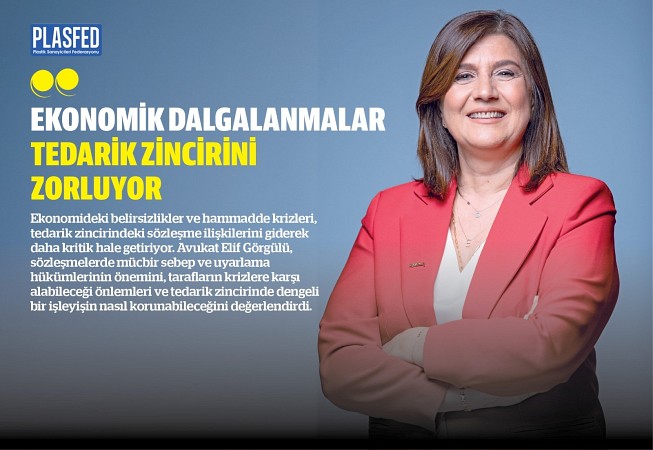
Uncertainties in the economy and raw material crises are making contractual relationships in the supply chain increasingly critical. Rising costs, delivery delays, and quality issues cause manufacturers and suppliers to face both economic and legal risks. Lawyer Elif Görgülü evaluated the importance of force majeure and adaptation clauses in contracts, the precautions parties can take against crises, and how a balanced operation can be maintained in the supply chain.
Uncertainties in the economy, sudden changes in exchange rates, and raw material crises are making contractual relationships in the supply chain more critical than ever. Especially in supply contracts that create an ongoing debt relationship, increasing costs, delivery delays, and quality problems bring both economic and legal risks. In this context, we discussed with Lawyer Elif Görgülü how suppliers and manufacturers can take precautions against these risks, and the role of force majeure and adaptation clauses in contracts. Görgülü evaluated contract strategies that will balance the rights and obligations of the parties in long-term supply relationships and legal measures that can be taken against possible crises.
Ms. Elif, how have the economic fluctuations and raw material crises in recent years affected contractual relationships in the supply chain?
The most common problems encountered in supply contracts are the increasing difficulty of performance due to rising costs, defective performance, delays in delivery, and damage during the delivery of goods. These problems sometimes arise from the parties' own faults, but more often from economic fluctuations, disruptions in the supply chain, or external factors constituting force majeure. Especially the economic fluctuations and raw material crisis experienced in recent years have caused suppliers to face problems in providing products and goods services. It has been observed that the uncertain monetary economy market and difficulties in accessing raw materials have caused a significant widening of the interest gap between the supplier and the recipient of goods and product services in terms of supply contracts that create a continuous debt relationship.
What should parties pay attention to in order not to be affected by these problems?
When preparing supply contracts, parties should clearly define elements such as delivery dates, delivery method, product standards, quality documents, inventory management, transfer of risk, and payment terms. It is extremely important to correctly determine the impact of force majeure and economic fluctuations on the contract. Undefined points can lead to serious commercial and legal disputes in the future.
Especially in long-term supply relationships, matters such as price adjustments, sharing of freight and insurance costs, and suspension of obligations in force majeure situations should be regulated in detail. It is as important for parties to adhere to the contract as it is for the contract to be prepared with the flexibility to adapt to changing economic conditions. Otherwise, one of the parties may bear a heavy burden due to economic fluctuations, sudden changes in exchange rates, or supply shortages. For this reason, it is undisputed that including protective "adaptation" and "force majeure" clauses in contracts will provide the supplier with greater protection against unexpected effects.
In the face of rising costs, what legal grounds can companies resort to when demanding contract adaptation?
Even if there is no provision in the contract, Article 138 of the Turkish Code of Obligations (TBK), which regulates "excessive difficulty in performance," is a directly applicable norm. The important thing is to prove the elements of "unforeseeability" and "excessiveness that renders payment impossible." The manufacturer must prove that the increased costs exceed the ordinary commercial risk limit and therefore performance cannot be expected from them. However, in practice, everything starts with documentation and good faith. Early written notification by the parties facilitates resolving the process through settlement without resorting to court.
How does the concept of "excessive difficulty in performance" in Article 138 of the Turkish Code of Obligations provide protection for manufacturers and suppliers?
As a rule, every merchant is obligated to act like a prudent businessperson. This obligation requires the merchant to act more foresightedly, carefully, and cautiously in business and contractual relationships compared to an ordinary person. However, extraordinary fluctuations in exchange rates in inflationary environments are often unforeseeable even by prudent merchants.
In this case, the supplier may file an adaptation lawsuit based on the provisions of excessive difficulty in performance under Article 138 of the Turkish Code of Obligations. If the supplier proves that performing their obligation has become contrary to the rule of good faith for them due to extraordinary economic conditions that emerged after the contract was signed, they can request the judge to adapt the contract to the new conditions; if this is not possible, they can request the termination of the contract. Especially in the plastics sector, a several-fold increase in raw material prices or an extraordinary rise in energy costs can be evaluated under this article.
If production quality decreases due to rising costs, who bears the responsibility for the resulting defective goods?
This is the breaking point of the business. When a manufacturer turns to lower quality raw materials to cut costs, a risk emerges that disrupts the fundamental balance of the contract. According to the Turkish Commercial Code (TTK) and the Turkish Code of Obligations (TBK), the manufacturer is responsible for the goods having "the qualities agreed upon in the contract." Furthermore, if the product has reached the end consumer, the Law on Protection of Consumers comes into play. Therefore, economic reasons—such as cost pressure, exchange rate differences, or supply difficulties—are not of a nature that can eliminate the obligation regarding quality. On the contrary, during such crisis periods, "greater diligence in maintaining quality" is expected from the manufacturer. Because trust established in the market is measured not only by the price of the product but also by its ability to maintain its standard.
So, can the manufacturer be absolved of responsibility in this situation on the grounds of "cost pressure" or "force majeure"?
Generally, no. The concept of force majeure concerns external events that make the performance of the debt completely impossible; a decrease in quality, however, is within the manufacturer's control. For example, if there is an import ban completely preventing the supply of raw materials or a natural disaster, this can be considered force majeure. However, if the manufacturer has chosen a different raw material to reduce costs, this is considered a commercial preference. The Court of Cassation is also quite consistent on this matter: economic difficulties, cost increases, or market contraction alone are not considered force majeure. Therefore, a manufacturer's deviation from quality standards on the grounds of "cost pressure" may constitute defective performance in the sense of the TBK. From a legal perspective, this distinction is important because in cases of force majeure, responsibility is lifted; whereas in defective performance, the manufacturer faces risks of both compensation and withdrawal from the contract.
How does the chain of responsibility work between the manufacturer, dealer, and consumer in the supply chain?
Essentially, the plastics sector is entirely built on a chain production model. There is a structure extending from the raw material supplier to the manufacturer, distributor, dealer, and final consumer. Each link is obliged to fulfill its contractual obligations, but if the source of the defect is in the production stage, the manufacturer bears the ultimate responsibility. A point worth mentioning here is the activation of the recourse mechanism. The dealer is the first point of contact for the consumer and is obliged to compensate for the damage; however, after making this payment, they have the right to seek recourse from the manufacturer or supplier. For this chain to function healthily, all technical tests, quality documents, and supply certificates in the production process must be fully archived. Otherwise, proving the source of the defect becomes difficult, and everyone along the chain falls under "collective responsibility."
Delivery delays also occur in the supply chain due to force majeure. Are these delays considered defective performance, or are they evaluated under the right to adaptation?
The nature of the delivery delay is decisive here. If the delay arises from an unforeseeable and unavoidable event—such as port strikes, international embargoes, or natural disasters—this situation can be considered force majeure. However, delays caused by internal organizational failures, staff shortages, or financial problems of the business will not be considered force majeure. When making this distinction, two main criteria are examined: Is there fault on the part of the party in the delay? Could the event have been foreseen by a reasonable merchant when the contract was established? If both criteria are not met simultaneously, the delay may fall under "defective performance." However, if there is truly an external crisis, the manufacturer can make an adaptation request under TBK Article 138 or be absolved of responsibility with a force majeure defense. Therefore, clearly defining provisions for delay, performance, and force majeure in every supply contract is vitally important.
How do rising costs affect the coverage limits of an insurance policy?
In inflationary periods, production costs, energy, and raw material expenses significantly increase; this situation raises economic risks across all links of the supply chain. As a result of rising costs: The value of insured goods increases, the production process becomes riskier, but the coverage limit in the insurance policy remains fixed.
In this situation, while the risk undertaken by the insurer actually increases, the policy coverage becomes insufficient to cover the real damage. Consequently, the supplier may be liable with their own assets for damages exceeding the policy limit.
Suppliers who do not want to be affected by damages outside the scope of insurance can add protective clauses to the contract in this regard. Furthermore, in accordance with the relevant provisions of the Turkish Code of Obligations and the Turkish Commercial Code, it is possible to request the adaptation or renewal of the policy to protect the balance of interests between the parties.
In such a complex web of responsibilities, how can businesses minimize their legal risks?
The most effective method is to adopt a "preventive law" approach in contractual relationships. This is because a large part of disputes arise from unforeseen risks during contract formation that cannot be managed afterward. Before signing a contract, a detailed scenario analysis should be conducted; a balanced structure should be established among the quartet of price, quality, delivery, and responsibility. Furthermore, contract management and quality control departments within the company need to work in coordination. Law on one side, and production planning on the other, should sit together at the table, collaborating to manage the process and reduce potential risks to a minimal level. By adopting this preventive law approach through collaboration, the aim should be not only to reduce litigation risk but also to prioritize protecting the brand, reputation, and supply chain security.
What steps should be taken to increase awareness in the plastics sector regarding this issue and to create protective contracts?
Economic fluctuations, raw material shortages, or exchange rate pressures do not legitimize fundamentally altering contractual relationships. Both manufacturers and suppliers should remember that law exists to maintain stability. Hasty revisions made today against sudden cost increases can become the cause of tomorrow's most complex disputes. The plastics sector is like a chain; each link is reliably connected to the next. It must remain connected. Manufacturers must adhere to contracts by preserving quality; suppliers, on the other hand, must fulfill their delivery and raw material responsibilities with honesty. Because when one link of this chain weakens, not only the economic flow but also the legal balance is disrupted. Reducing quality or relaxing delivery obligations due to short-term cost concerns creates temporary relief but leads to permanent loss of reputation. However, well-prepared contracts, with clear force majeure and adaptation clauses, are the strongest "insurance" protecting both the manufacturer and the supplier. In this context, preparing realistic and flexible contracts with legal support is extremely important. Today, the true test for industrialists is to be able to make contract awareness an institutional reflex without panicking in the face of crisis. Establishing balance in the supply chain is no longer just an economic matter but a legal sustainability issue, and businesses that can maintain this balance will be the reliable brands of tomorrow. The sector's continued existence with confidence depends on the presence of contracts prepared within a relationship of trust.
This content has been translated using artificial intelligence technology.