




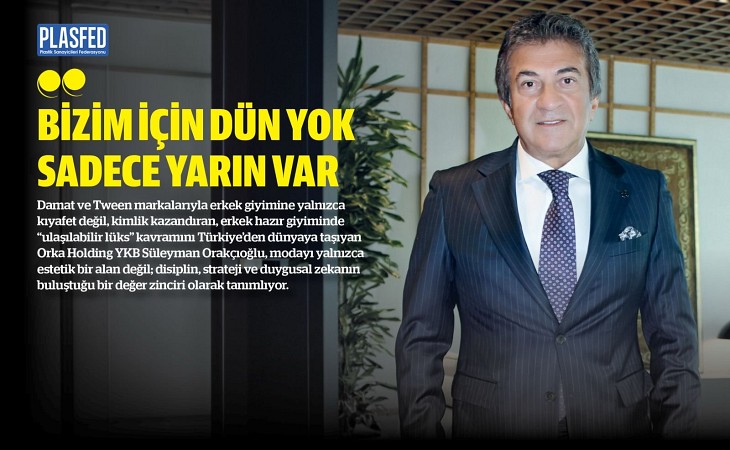
Süleyman Orakçıoğlu, Chairman of the Board of Orka Holding, who has brought not only clothing but also an identity to menswear with the Damat and Tween brands, and who has carried the concept of “accessible luxury” in men's ready-to-wear from Turkey to the world, defines fashion not merely as an aesthetic field, but as a value chain where discipline, strategy, and emotional intelligence converge. For Orakçıoğlu, who bases his dream of becoming a global brand on a mathematical vision rather than coincidence, success means creating a sustainable reputation and social impact beyond growth figures.
Süleyman Orakçıoğlu, the architect of a groundbreaking journey in men’s ready-to-wear in Turkey, views business life not as a cycle of repetition fed by the habits of the past, but as a process of transformation that constantly reinvents the future. Transforming the personal dream he started in Elazığ into powerful brands showcased in windows across different geographies of the world today, Orakçıoğlu positions Damat not only as a commercial success story, but as concrete proof that Turkish brands can have a say on the global stage.
Offering striking assessments on many topics, from changing consumer habits to the subtleties of branding in menswear, and from the evolving meaning of leadership to the advantages and challenges of manufacturing in Turkey, Orakçıoğlu delivers powerful messages about the business world with his approach that combines emotional intelligence with design, his leadership model based on collective wisdom, and his vision of creating sustainable value. Through his advice to young people, he reminds them that success is born not from short-term results, but from processes built with patience. Explaining the formula for remaining permanent in global competition with the Damat and Tween brands, Orakçıoğlu evaluates the changing dynamics of branding, leadership, and production with a sincere perspective for PLASFED Magazine.
Could we briefly get to know Süleyman Orakçıoğlu? How did your journey into business life begin?
My journey is actually a story of dreaming of "becoming a global brand" and building that dream with mathematical discipline... My childhood dream, my field of interest, and my curiosity, which started in Elazığ, combined with the rhythm of trade during my university years. I aimed not just to sell products, but to create value together with my brother, Halidun Orakçıoğlu.
That initial desire to "do the best" is the fundamental source of motivation that still wakes me up every morning with the same excitement. I can say that for me, business life is the art of discovery, risk-taking, and stepping out of the comfort zone, rather than routine working hours.
How did the founding story of Orka Holding and the Damat brand take shape? What does the Damat brand mean to you today?
In the early 1980s, while there were copies of each other's products in the market, we laid the foundations of the "accessible luxury" concept that would reflect a man's self-confidence in his clothing and give him an identity.
Today, Damat is not just a brand to me; it is concrete proof of my belief that a Turkish brand born from these lands can wave our flag in world capitals and on the most prestigious streets… Damat is the DNA of our global vision and our first labor of love.
What do you think is the most critical element of surviving for many years in the men's ready-to-wear sector and being a powerful brand in menswear?
For us, there is no such concept as yesterday; there is only tomorrow. The most critical element for us is being able to transfer emotional intelligence to design. You need to build a bridge of loyalty with your customer, not just a shopping connection.
When you build a structure that doesn't follow trends but stays one step ahead of them, blending technology with the art of tailoring, your ship continues to move forward no matter which direction the wind blows.
How has the target audience of Damat and Tween brands changed over time? How do you read the new generation consumer?
It has evolved from "age groups" to "lifestyles." While we used to focus only on professionals wearing suits, today we appeal to a crowd that travels the world, digitizes, cares about sustainability, and wants both "comfort" and "elegance" at the same time.
We see the new generation consumer not just as a buyer, but as a community partner. They want sincerity and transparency; and we promise them not just a jacket, but a lifestyle and an ethical stance.
How have the experiences you have gained in the business world today transformed your understanding of leadership over time?
As years went by, I learned that leadership is not about "giving orders," but about "inspiring and creating space." While I had a controlling personality in my early years, dealing with every detail personally, today I am a leader who believes in collective wisdom and the power of delegation.
For me, a good leader is someone who can gather people more talented than themselves around the same vision…
My experiences have shown me that ego is the greatest enemy of success. I structure my leadership on a triple helix: empathy, speed, and flexibility.
What do you think are the biggest structural problems of the ready-to-wear and retail sector in Turkey today? In your opinion, which structural steps should be prioritized for the development of the industrial and production ecosystem in Turkey?
One of the most structural problems is the loss of speed in the transition from "price-focused production" to "value-focused branding." The era of becoming a world giant just through subcontracting is over. For the development of our industrial ecosystem, a state policy that encourages design, R&D, and digitalization, and places value-added production at the center, is essential.
We must urgently implement models where university-industry cooperation does not remain on paper, but where young people become real players in factories and design offices.
What are your hobbies that balance you during your busy work schedule? What do you do when you are completely disconnected from work?
Art, sports, and exploring different cultures… When I am completely disconnected from work, I refresh my soul with a walk in nature or by getting lost in an art gallery.
Outside of work life, what kind of meaning does social and community life hold for you?
Social and community life is a learning space for me where I fulfill my responsibilities to society and feed off of different disciplines. If you do a job focused on people, you have to touch every color of life; otherwise, both your design and your vision will be incomplete.
How do you define success today? Has this definition changed over the years?
Defining success as "numbers and growth rates" is in the DNA of the business. However, today, for me, success is also about how many lives you touch, how much sustainable value you create, and what kind of reputation you leave behind….
Finally, how do you evaluate the young generation's view of business life, and what would be your one fundamental piece of advice to young people stepping into the business world?
Very energetic and sometimes impatient… "Focus on the process, not the result." If you love that demanding process in the kitchen of your work, success will come naturally as an inevitable by-product.
As an industrialist, what are the biggest advantages and the most challenging aspects of manufacturing in Turkey?
The advantages are our incredible agility during moments of crisis and our ability to make happen what is called "impossible"... Our young workforce and logistical location make us unique in the world. When we look at the other side of the coin, there are structural obstacles such as raw material dependency, high energy costs, and the difficulty of finding qualified labor. As an industrialist, producing in Turkey is both very tiring and equally satisfying, like making moves on a chessboard every day…
In Turkey, when fashion is mentioned, women's clothing usually comes to the forefront. Do you think it is harder to brand in menswear?
I wouldn't say it's harder, but I can say that branding requires much more discipline. A one-millimeter error in the pattern or a tiny flaw in the texture of the fabric is immediately detected by the male customer's radar.
I think winning over the male consumer is a much tougher test… Men are loyal if they trust, but gaining that trust requires patience. We turned this challenge into an advantage and created our own playing field by transforming the classic, stereotyped habits of men with a modern aesthetic.
This content has been translated using artificial intelligence technology.