


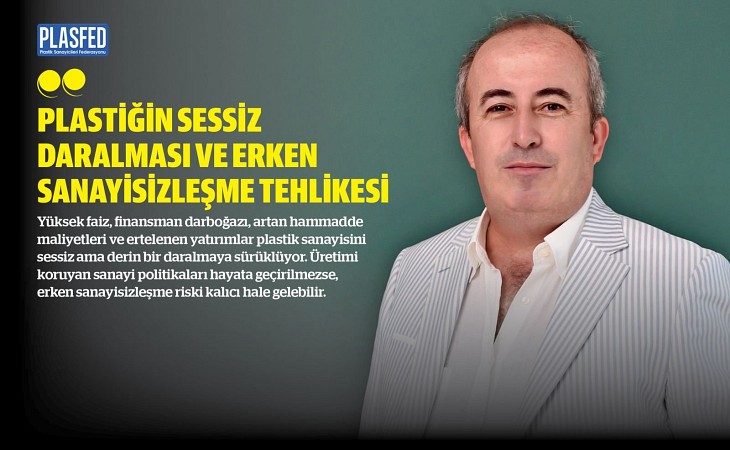
THE SILENT CONTRACTION OF PLASTICS AND THE DANGER OF PREMATURE DEINDUSTRIALIZATION
High interest rates, financing bottlenecks, rising raw material costs, and postponed investments are driving the plastics industry into a silent yet profound contraction. If industrial policies that protect production are not implemented, the risk of premature deindustrialization could become permanent.
Ömer ÖZKUL
Chairman of the Board
Denizli Plastics Industrialists and Recyclers Business Association (DEPSİAD)
The Turkish economy is undergoing a painful disinflation process caught in the grip of high inflation, high interest rates, and a suppressed exchange rate. However, the cost of this balancing act is increasingly falling heavily on the manufacturing front. What is happening in industrial corridors is no longer a temporary slowdown; it is a hard-to-reverse risk threatening production capacity, investment, and employment: premature deindustrialization. Today, the warning that 'Turkey faces the risk of premature deindustrialization' is the national-scale counterpart of the reality we have been experiencing in our factories in Denizli for months. Our plastics and packaging industry is among the primary areas where we see this picture most concretely.
THE DANGEROUS WEDGE BETWEEN VOLUME AND VALUE
Even though our sector's figures in value terms give the appearance of growth, physical production data tells the exact opposite. In the first half of 2026, plastic product production increased by 5.5% in value terms to reach $23 billion, while decreasing by 4.1% in volume terms to fall to 4.99 million tons. Consumption in the domestic market also dropped by 7% in the same period to 4.07 million tons. Behind the increase in value terms lies inflation and rising input costs rather than growth. This contraction is also reflected in capacity utilization. The average capacity utilization rate in the sector in the first half of 2026 dropped to 73.9%, remaining 1.5 points below the same period of last year.
THE PARALYSIS OF OUR WILL TO INVEST
The most important indicator of deindustrialization is how much the industrialist can invest in tomorrow. In an environment where access to finance becomes difficult and costs rise, new machinery investments are postponed. The fact that machinery investments in the plastics sector decreased by 18% in the first half of 2026, falling to $562 million, is a concrete indicator of this loss of confidence. Today, our industrialists are trying to survive with their existing machinery park rather than creating new capacity. The cessation of investment not only slows down today's growth; it also weakens tomorrow's production power, competitiveness, and employment.
RAW MATERIAL EARTHQUAKE AND LOGISTICS FIRE
Turkey's 85% dependency on imports for plastic raw materials directly carries global crises into our production costs. Geopolitical and logistic risks that increased with the attacks launched by the USA and Israel against Iran on February 28, 2026, led to shocking increases in raw material prices. Between February and April 2026, ABS injection increased by 103.2% from $1,575 to $3,200, while PPH raffia increased by 97.5% from $1,220 to $2,410. It is not possible to talk about healthy production planning in an environment where the producer cannot foresee their costs. Sectors to which we provide inputs, such as textile, automotive, and white goods, are directly affected by this fracture.
THE SEVERE TEST WE EXPERIENCE IN DENİZLİ
We cannot separate Denizli from this storm. Our city is one of Turkey's top 10 production centers with its 23 packaging manufacturers. However, our facilities declaring concordat or going bankrupt due to the financing bottleneck demonstrate the scale of the crisis. The process of our sector shifting abroad is not new; this quest, which started with investments in Romania and Morocco in 2024, is turning into a serious risk of production loss today in 2026 with Egypt's aggressive cost advantage. Eastern Europe's low-cost production is also squeezing us in our main markets. Every facility we lose rips capital, employment, and our production culture accumulated over generations out of this city.
We Must Protect Production
Premature deindustrialization is no longer a theoretical debate; it is a concrete reality where production slows down and investments stall. To reverse this course, additional import taxes on raw material items where domestic production is insufficient must be lifted immediately, and industrialists must be enabled to compete with world prices. For producers undertaking public tenders at fixed prices, this raw material shock must be accepted as a force majeure, and price difference mechanisms must be activated. A model that consumes our production capacity while lowering inflation is not sustainable. What Turkey needs is a disinflation policy that does not sacrifice production and a decisive industrial policy that will enable industrialists to look to the future with confidence. Because if we lose production, we lose not only today, but the Turkey of the future.
This content has been translated using artificial intelligence technology.