




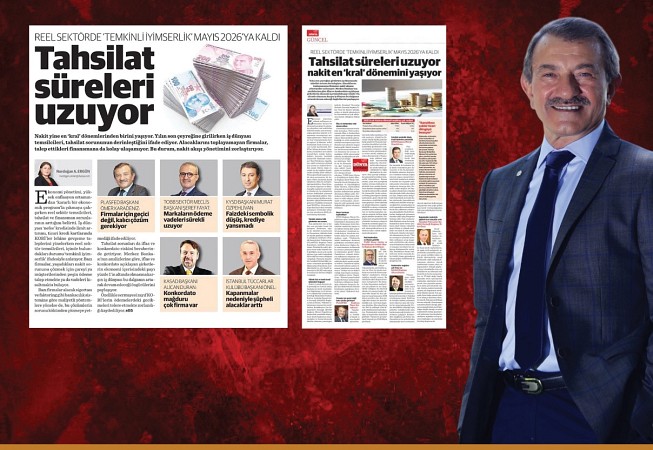
Cash is experiencing one of its 'king' periods again. As the year enters its last quarter, business representatives express that the collection problem is deepening. Companies unable to collect their receivables are also struggling to access the financing they request. This situation complicates cash flow management.
While the economic management attempts to emerge from the high inflation environment with a 'stable economic program,' representatives of the real sector indicate that collection and financing problems have increased. The business world reiterates demands for limit increases in 'breathing' credit and relaxations in commercial credit cards in favor of SMEs, while real sector representatives describe their situation as 'cautiously optimistic.' Some firms are seeking solutions to their cash issues by either requesting advance payments from their customers or shortening payment terms.
Although some firms are turning to costly methods according to the banking system, such as receivables insurance and factoring, it is stated that these solutions are not sufficient to solve the problem at its root.
Collection problems also bring along the risk of bankruptcy and concordatum. According to the Central Bank's analyses, although the share of companies declaring bankruptcy and concordatum is below 1% within the economy, the business world predicts that this wave will continue to increase.
It is noted that particularly small-capital SMEs are struggling to tolerate delays in payments.
As the year enters its last quarter, the collection problem is deepening in the business world. Companies that cannot collect their receivables are having difficulty managing cash flow. According to the analyses of the Central Bank, although the share of companies declaring bankruptcy and concordatum is below 1% in the economy, the business world shares predictions that this wave will continue to grow.
While economic management endeavours to emerge from the high inflation environment with a 'stable economic program,' the rising voices from the real sector indicate that collection and financing problems are increasing as we enter the last quarter of the year.
Cash is living through one of its 'king' periods again. The business world reiterates demands for limit increases in 'breathing' credit and relaxations in commercial credit cards in favor of SMEs, while real sector representatives describe their situation as 'cautiously optimistic.' It is stated that some firms are seeking solutions to their cash problems either by requesting advance payments from their customers or shortening payment terms. The cash flow problem experienced across the market is noted to create a domino effect, making it even harder to collect receivables. Although some firms are turning to costly methods like receivables insurance and factoring, it is expressed that these solutions are not sufficient to solve the problem at its roots. Collection problems also bring along the risk of bankruptcy and concordatum. Particularly, small-capital SMEs are having difficulty tolerating delays in payments. Producers are pinning their hopes for recovery on the year 2026.
Collection problems remain the main issue on the agenda
Some businesses, even though they expect a partial improvement in the last quarter, state that collection problems and the burden of financing are still the biggest agenda items. Ömer Karadeniz, President of the Plastic Industrialists Federation (PLASFED), emphasized that cash flow has become a bit more regular in companies that export, but cash tightness is still a serious issue for many businesses. He drew attention to the fact that the 'cautiously optimistic' sentiment felt in the market should not be misleading, especially underscoring that cash flow issues continue for small and medium-sized enterprises (SMEs).
The umbrella organization PLASFED's President continued his remarks:
“Collection problems have a more pressuring effect, especially on small and medium-sized enterprises. This is because these firms do not have a strong financial structure like large companies and are struggling to tolerate delays in payments. They often have to revise their production planning, rearrange payment terms, and carry the burden of financing. A chain effect occurs; when a payment is delayed somewhere, it reflects on other businesses as well. As we approach the last quarter, there is a sense of optimism in the market. The reason for this is the expectation of increased demand in the last quarter of the year and the partial stabilization of raw material prices globally. However, this optimism is cautious optimism. This is because merely a few indicators showing a positive trend does not mean all problems are solved. The biggest expectation of the real sector is the restoration of predictability and a secure environment. Investment and production decisions can only be made more robustly with this environment. Companies are trying to produce various solutions under current conditions. However, these solutions are temporary in nature. The root solution to the problem lies in permanently ensuring confidence and stability in the economy.”
Translated by Artificial Intelligence