

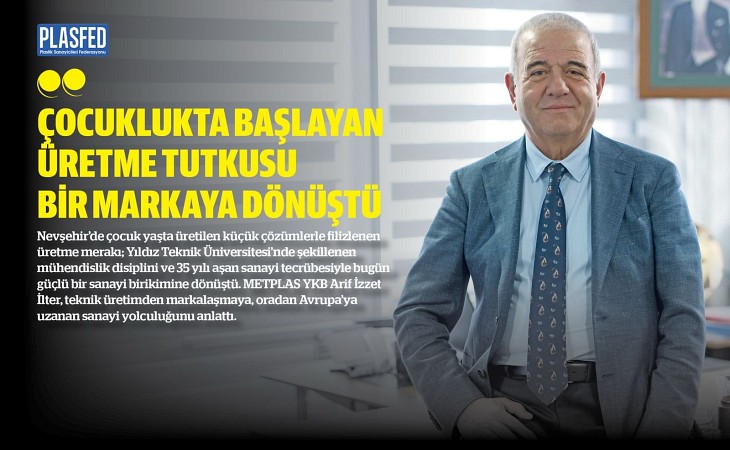
The curiosity for production, which sprouted with small solutions created during childhood in Nevşehir, has transformed into a strong industrial legacy today, shaped by engineering discipline at Yıldız Technical University and over 35 years of industrial experience. Arif İzzet İlter, Chairman of the Board of METPLAS, spoke about his industrial journey that extends from technical production to branding and then to Europe, as well as his assessments regarding the transformation of the Turkish plastics sector. İlter emphasizes that production is not merely about machinery and capital, but a value that grows with effort, patience, and vision.
When people speak of industry in Turkey, they often talk about machinery parks, capacity figures, and export data. However, behind this picture lies an instinct for production that often sprouts in childhood years, a learning process based on labor, and a long-term journey of patience.
Arif İzzet İlter, founder and Chairman of the Board of METPLAS Metal ve Plastik Sanayi AŞ, is one of the most authentic examples of this journey. His life, which began in Nevşehir in a family not directly connected to industry and trade; engineering education at Yıldız Technical University, factory experiences gained during Turkey’s industrialization years, and ultimately, a brand story that extends to Europe today. We discussed the METPLAS journey, which spans from technical production to branding and then to a global industrial structure, in all its dimensions.
Your ability to design and produce goes back to your childhood years. Was it like this from the beginning?
Yes, I can say this very clearly; this started in childhood. I am originally from Nevşehir. My late father was a teacher. Our family was not one intertwined with industry or trade. However, my hands were always adept, and I had a desire to produce things and find solutions. When I look back today, I realize this was actually an engineering reflex. Seeing a need and creating a solution for it... This feeling never disappeared.
Did the dream of engineering take shape in those years as well?
Absolutely. I always wanted to be an engineer. God willed it; I won a spot in the Mechanical Engineering department at Yıldız Technical University. When I came to Istanbul, both the city and the university were a very different world for me. I was very impressed by the environment, which was not unlike Yıldız Park, when I first walked around the school campus. I felt that the students were generally relaxed and happy. Meanwhile, I learned that the school had an evening program. At that moment, I was overcome with the desire to continue evening education while working in a job related to my field. Because I believed that combining education with workplace knowledge and experience would provide me with many benefits and opportunities. In addition, I would be reducing the burden on my family. However, since I had already registered for the day program, the process of transferring to the evening program was a bit tiring, but I was very happy when it happened. The evening program was one year longer, meaning five years. There were classes on weekday evenings between 18:00 and 23:00, and half-day classes on Saturdays. Of course, it was quite a heavy schedule for a working student. This difficult and arduous period holds many valuable benefits and gains for a young person. Above all, you never forget how valuable time is.
You also start working during that period...
Yes. After a while, I started working in the plastics manufacturing department of a factory that was a subsidiary of a major holding company. It was a great stroke of luck for me that it was a factory with quite advanced technological facilities for that time. In a short time, I mastered every stage of production. Being appointed as the manager of that department while I was still a student made me even more successful and determined.
How did the idea of starting your own business arise when you had such a career?
My earnings were good, in fact, very good. But the issue was not money. There was a desire to start my own business. I worked as a manager for a while longer, then I bought a few machines and set out on my own path. My first customers were the bosses of the factories where I had worked before. This gave me a serious advantage of trust at the very beginning of the business.
Should we start the METPLAS foundation story from here? How would you summarize your founding story and the point you have reached today?
METPLAS Metal ve Plastik Sanayi A.Ş. was founded in Istanbul in 1988 with limited resources; with the goal of bringing the plastic and metal industry together with a quality-oriented production approach. It grew not from strong capital, but from a belief in production, discipline, and a determination to do things right. Today, with over 35 years of experience, it stands as an industrial organization that exports, creates employment, and adds value to the sector. With our Rubikap brand, which is a reflection of our innovative approach, we are proud to be a known and preferred Turkish brand in Europe.
What were the turning points in the company’s growth process?
The most important turning points in the growth of METPLAS Metal ve Plastik Sanayi A.Ş. were the technical expertise gained through contract manufacturing in the early years of its establishment, the strengthening of the corporate identity by focusing on our own brands in the early 2000s, and starting exports in 2009. Finally, with the establishment of Rubikap GmbH in 2024, our presence in Europe gained a corporate structure. This process shaped METPLAS's development journey, which extends from technical production to branding and globalization.
How do you evaluate the current state and development potential of the Turkish plastics industry?
The Turkish plastics industry is at a very strong point today in terms of both production capacity and product variety. We have become one of the leading production centers in Europe. Our entrepreneurial structure, flexible production capability, and ability to adapt quickly provide a significant competitive advantage in global markets. However, some structural problems of the sector cannot be ignored. Dependency on foreign sources for raw materials, global price fluctuations, and energy costs are among the biggest pressure points for industrialists. In addition, the lack of qualified labor and the inadequacy of vocational training are among the factors limiting productivity in production.
What is your approach to the difficulties faced by industrialists regarding raw materials and energy?
These three topics are at the top of the agenda for almost every industrialist producing in Turkey today. As METPLAS, we diversify our supply chain on the raw material side and manage stock planning with long-term strategies. On the energy side, we prioritize efficiency investments. We try to reduce energy consumption through automation and process improvements, and we continue our feasibility studies regarding the transition to renewable energy.
Can you talk about your vision for digitalization, automation, and sustainability?
We treat digitalization not just as a software investment, but as a transformation of the production culture. Thanks to ERP and production monitoring systems, we can track all processes instantaneously. We position automation not as an alternative to human power, but as a tool that supports it.
What are the reasons for preferring polycarbonate and unbreakable products over glass in the yacht industry?
Material selection in the yacht and maritime industry is of great importance not only for aesthetics but also for safety and performance. Although glass is a stylish material, it poses serious risks in a marine environment due to its weight and fragile structure.
Polycarbonate, on the other hand, is about 50 percent lighter than glass, yet has a much higher impact resistance. This feature both increases safety on yachts and contributes to fuel efficiency. Furthermore, its thermoformable structure offers producers significant design freedom.
What solutions do you offer as METPLAS to the yacht and maritime industry? What are the advantages of your products in this field?
METPLAS Metal ve Plastik Sanayi A.Ş. offers specialized polycarbonate kitchen and service products for the yacht and maritime industry under the Rubikap brand. Cups, plates, bowls, and storage equipment provide safe and long-lasting use in marine conditions with their unbreakable, lightweight, and food-safe structure. Thanks to high optical clarity and UV resistance, the products maintain the elegance of glass, while offering the advantage of being lightweight, which contributes to weight balance on yachts, in addition to their aesthetic appearance. Thus, safety, durability, and aesthetics are provided together.
What message would you like to give to our readers today about how an industrialist in Turkey can survive?
The most fundamental condition for being an industrialist today is adapting to change. Innovation, financial discipline, investment in technology, and a strong team are indispensable. However, the most important value that stands above all of these is honesty and reputation. This is also the greatest capital that keeps a company afloat during times of crisis. An industrialist's greatest strength is not their machinery or capital, but their reputation. One should pursue long-term trust, not short-term gains. As METPLAS and Rubikap, we continue our path with this understanding, and we sincerely believe in the future of the Turkish industry.
This content has been translated using artificial intelligence technology.