




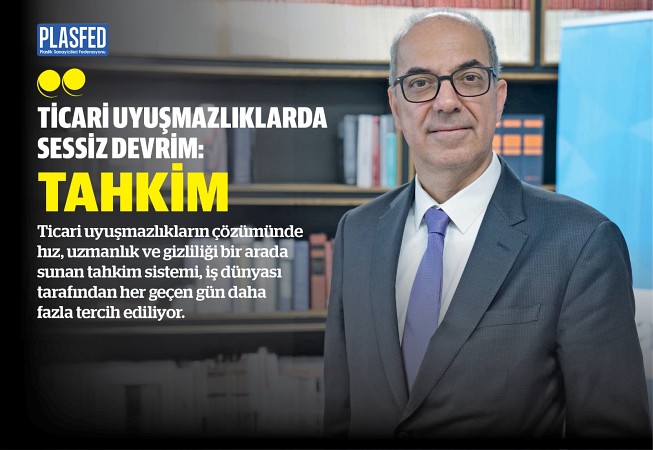
The arbitration system, which offers speed, expertise, and confidentiality in the resolution of commercial disputes, is increasingly preferred by the business world. Prof. Dr. Ziya Akıncı, Chairman of the Board and Council of the Istanbul Arbitration Centre, explained Turkey's current position in arbitration and their vision to make Istanbul an international arbitration hub.
For those seeking a fast, expert, and confidential solution in commercial disputes, arbitration offers an effective alternative beyond traditional judiciary. With binding decisions in a short time, lower costs, and arbitrators who are industry experts, arbitration is becoming the new preference of the business world.
By the nature of commercial life, disputes are inevitable. However, today's business world no longer wants to leave these problems to lengthy judicial processes. Arbitration, standing out among alternative dispute resolution methods, has become one of the solution methods needed by commerce with its advantages such as speed, expertise, confidentiality, and flexibility.
The Istanbul Arbitration Centre (ISTAC), Turkey's most important institution in this field, is rapidly becoming a preferred centre not only for national but also for international disputes. We spoke with Prof. Dr. Ziya Akıncı, Chairman of the Board and Council of the Istanbul Arbitration Centre, about the Centre's journey from its establishment to the present, the opportunities arbitration offers to the business world, and Turkey's position in the field of arbitration.
Arbitration has become an increasingly preferred method for resolving disputes, especially commercial ones. In short, what is arbitration?
Arbitration is a dispute resolution method in which disputes that parties can freely dispose of are resolved by arbitrators determined by themselves, instead of the state's official judicial bodies. Arbitration is a direct judicial activity that includes a petition stage and a hearing, similar to judicial proceedings. An arbitral award is binding and enforceable, just like a court decision. However, for arbitration to take place, the parties must either enter into an arbitration agreement or add an arbitration clause to their contract without any reference to a court.
Why should the business world prefer arbitration for dispute resolution?
In fact, arbitration has very important features that meet the needs and expectations of the business world. The business world needs speed at almost every stage, especially regarding cash flow. Commerce is dynamic, and arbitration is the best way to meet this need. In arbitration, results can be obtained much faster compared to courts. For example, at the Istanbul Arbitration Centre, which I chair, a binding decision is delivered within six months in normal arbitration proceedings, and within three months in expedited arbitration proceedings. Today, disputes under 5 million TL are resolved in expedited arbitration within three months at our Centre.
Another important point is that there are various sectors in our country where our companies operate. The needs and expectations of each sector are naturally different from each other. In addition, each sector has its own specific legal regulations and customs. In arbitration, the proceedings are conducted by arbitrators who have special technical and sectoral knowledge regarding the dispute. Parties consider the arbitrator's knowledge in that sector when selecting an arbitrator. This point is also taken into account when an arbitrator is appointed at the Istanbul Arbitration Centre.
What do you think is the most important feature of the system?
Perhaps the most important feature of arbitration is the confidentiality of the file. Hearings are confidential, decisions are confidential, which allows parties to protect their trade secrets and reputations.
There are many other reasons why arbitration is preferred. These include the fact that the parties' wills are much more prominent in arbitration and that it requires less formality compared to courts. For example, the parties can determine the language to be used in resolving their dispute and the seat of arbitration by their own will. So, when we say Istanbul Arbitration Centre, we shouldn't think that disputes are resolved only in Istanbul. For example, there are disputes resolved in Ankara, Konya, Gaziantep. Furthermore, the Istanbul Arbitration Centre Secretariat can provide services in many languages such as English, German, and French. Thus, the parties' freedom of will regarding the language of arbitration is also supported by the Secretariat.
How do you evaluate the development of arbitration in Turkey? What kind of progress has been made in this field in recent years?
Especially with the increasing interest of the business world in alternative dispute resolution methods, arbitration has become a highly preferred mechanism. The establishment of the Istanbul Arbitration Centre has also been a major factor in this development. The Istanbul Arbitration Centre has very serious experience; since its establishment, it not only provides qualified arbitration services but also carries out intensive awareness and training activities to establish an arbitration culture. Today, we have invaluable arbitrators in Turkey, each on their way to becoming a doyen in their field. Our arbitrators deliver excellent decisions.
It is also worth mentioning the Court of Cassation here. Our Court of Cassation is very arbitration-friendly, rendering excellent decisions that instill confidence in both national and international arenas. This now creates an environment for Turkey and the Istanbul Arbitration Centre to be accepted and used not only in national arbitrations but also in international arbitrations.
Let's talk a bit about the Istanbul Arbitration Centre. Why and how was the Istanbul Arbitration Centre established?
The Istanbul Arbitration Centre was established in 2015 with Law No. 6570 as part of the Istanbul Finance Centre project. It aimed to carry out the necessary activities for the implementation and widespread adoption of arbitration and other alternative dispute resolution methods.
The general assembly of the Istanbul Arbitration Centre includes TOBB, TBB, YÖK, TİM, the Ministry of Justice, the Banks Association of Turkey, the Participation Banks Association of Turkey, CMB, Borsa Istanbul, BRSA, CMB, TESK, and TİSK. These institutions are very valuable because this structure actually brings together the business world and the legal world. Great responsibilities fell upon these institutions for the dissemination of arbitration and for Turkey to establish itself in the world of arbitration.
You might ask, isn't arbitration confidential? Do institutions see our files? Every institution and every organ of the Istanbul Arbitration Centre fulfills its own responsibility. Our institutions and other organs are not aware of the files; privacy is paramount. This is very valuable.
What is the goal of the Istanbul Arbitration Centre? What have you achieved so far?
The goal of the Istanbul Arbitration Centre is to make Turkey a trusted and leading country in arbitration and other dispute resolution methods. It is very important not to leave question marks in the minds of the parties with judicial activity and for the reasoning provided to be satisfactory.
So, how is the Istanbul Arbitration Centre pursuing this goal?
The Istanbul Arbitration Centre has achieved great successes. We have become the third largest arbitration centre in Europe in terms of case numbers. To increase arbitration awareness in Turkey, we organized many training sessions and conferences in cooperation with numerous institutions and organizations, including universities and professional bodies. At the point we have reached today, disputes from many cities in Turkey are resolved at the Istanbul Arbitration Centre. Foreign parties also readily accept the Istanbul Arbitration Centre and are very open to bringing their disputes here. Companies established in many countries around the world (such as the USA, Germany, UK, Poland, Belgium, China, Senegal, Kyrgyzstan, Russia, Iran) resolve their disputes at the Istanbul Arbitration Centre. The Istanbul Arbitration Centre being a respected centre both in our country and abroad is a very valuable achievement not only for us but also for our country.
What are the most important factors contributing to this success?
Of course, the contributions of the names in our Councils are also significant. In our National Council, along with me and our Secretary General, there are Prof. Dr. Ejder Yılmaz, the teacher of teachers, and Prof. Dr. Celal Göle. In our International Council, apart from us, there are some of the biggest names in arbitration such as Gary Born, Dr. Hamid Gharavi, and Prof. Dr. Bernard Hanotiau, whom we can easily call the Ronaldos and Messis of arbitration.
Furthermore, we are an innovative arbitration centre. We follow technological developments and strive to adapt these developments to arbitration. We are also the first arbitration centre in the world to institutionalize the med-arb practice with its rules. We like to act with a pioneering and creative vision in such matters. We have established many specialized commissions within our structure, and they provide very valuable contributions to the spread of arbitration and meeting sector needs.
Is the reason for having an International Council with foreign experts also due to the presence of foreign cases?
Yes, the Istanbul Arbitration Centre was designed not only to resolve domestic disputes but also international ones. Indeed, disputes involving foreign parties are also resolved at our Centre. While in our international cases, one party is predominantly Turkish and the other foreign, in the last two years, we have started receiving applications where both parties are foreign. This can be considered the first results of our efforts towards achieving our goal of making Turkey a dispute resolution venue in the region.
How will the business world benefit from the Istanbul Arbitration Centre?
It's actually quite easy; it is sufficient for the business world to write in their contracts: “All disputes arising out of or in connection with this contract shall be finally resolved by arbitration in accordance with the Istanbul Arbitration Centre Arbitration Rules.” Of course, if a court clause appears elsewhere in the contract, it would cause issues, so it's necessary to avoid including any court clause.
You just mentioned that you are the first arbitration centre to institutionalize the med-arb practice. What kind of method is Med-arb? Should it be preferred?
As the Istanbul Arbitration Centre, we became the first arbitration centre in the world to systematize the med-arb practice with its rules. Med-arb, as its name suggests, is a tiered (or phased) dispute resolution method that combines mediation and arbitration.
In this system, parties are first given the opportunity for mediation to reach an amicable agreement; if the parties cannot agree at this stage, the arbitration proceedings continue, leading to a final decision. This method can benefit parties in terms of cost and time. With our Med-arb rules, we have seen many examples where parties reached an agreement. The culture of consensus is very important for the business world because sometimes you don't want to reach the litigation stage with people you will continue to work with. Therefore, if you ask whether it should be preferred, absolutely yes. As in arbitration, it is sufficient to add to your contract that disputes will be resolved in accordance with the Istanbul Arbitration Centre Med-Arb Rules.
Is there a message you would like to convey before we conclude?
I would especially like to give this message to the business world and the legal community: We now have a domestic alternative for dispute resolution at global standards. The Istanbul Arbitration Centre is not just a judicial institution, but also a strategic institution that enhances Turkey's competitiveness. The adoption and appreciation of arbitration, alternative dispute resolution mechanisms, and the Istanbul Arbitration Centre will directly and positively impact our country's investment environment.
Who is Prof. Dr. Ziya Akıncı?
I was born in İskenderun. Due to my father being a Public Prosecutor, I lived in the places where he served. I am a graduate of Dokuz Eylül University Faculty of Law. I completed my master's degrees at Ankara University and Exeter University, and my doctorate at Istanbul University. I am the Head of the International Private Law Department at Galatasaray University, and also the founding partner of Akıncı Law Office. I serve as the Chairman of the Board and Council of the Istanbul Arbitration Centre. Previously, I was also a member of the ICC Court. To date, I have served as an arbitrator and party counsel in many international arbitration cases.
This content has been translated using artificial intelligence technology.