
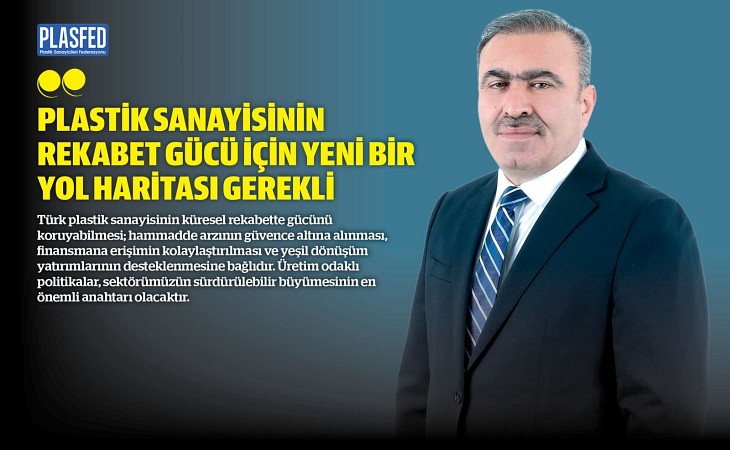
FOR THE COMPETITIVENESS OF THE PLASTIC INDUSTRY
A NEW ROADMAP IS NEEDED
The ability of the Turkish plastics industry to maintain its power in global competition depends on securing the supply of raw materials, facilitating access to finance, and supporting green transition investments. Production-oriented policies will be the most important key to our sector's sustainable growth.
Yunus TARLA
Kayseri Plastics Industrialists Association (KAYPİDER)
Chairman of the Board
The Turkish plastics industry is one of the strategic areas of the national economy with its production capacity, export performance, and contributions to many sectors. As an indispensable link in a very wide production chain ranging from packaging to automotive, white goods to furniture, our sector empowers the economy with the added value and employment it creates. Kayseri, on the other hand, is one of the most important representatives of this success with its production culture, entrepreneurial spirit, and industrial infrastructure.
Today, raw material dependency is at the forefront of the most important structural problems facing our sector. Our heavy reliance on foreign sources for plastic raw materials causes global price movements, exchange rate fluctuations, and logistics costs to be directly reflected in production costs. Increasing domestic petrochemical investments and strengthening raw material supply security are no longer a choice, but a necessity to maintain our competitive power.
Another important issue is access to finance. High financing costs reduce the investment appetite of our businesses, especially SMEs. However, the sustainability of production is possible with new machinery investments, capacity increases, and technological transformation. The industrialist's access to finance under favorable conditions will directly affect the competitiveness not only of our companies but also of the country's economy.
COMPETITION IS NOT ONLY SHAPED BY PRICE
Competition in global markets is no longer shaped solely by price. Quality, sustainability, innovation, and a low-carbon production approach are also among the determining factors. The transformation in international markets, especially the European Union's environment-oriented regulations, also offers important opportunities for our sector. Increasing recycling investments, expanding circular economy practices, and transitioning to eco-friendly production technologies will strengthen our competitive advantage.
In addition, digitalization and automation investments are of critical importance in terms of efficiency. Businesses that manage production processes more effectively, reduce energy consumption, and raise quality standards achieve a stronger position in global competition. Supporting this transformation process more effectively with public subsidies will provide significant gains for our sector.
Another element that will determine the future of our sector is qualified human resources. Strengthening vocational education, integrating young people into production processes, and increasing cooperation between industry and educational institutions are of great importance. Technological transformation is only possible with trained human resources who will manage this transformation.
EVERY DIFFICULTY WILL BE OVERCOME WITH PRODUCTION POWER
The Turkish plastics industry has managed to overcome many challenges it has faced so far with its production power and entrepreneurial spirit. In the upcoming period, it is of great importance for the public sector, private sector, and non-governmental organizations to act with a common mind. Strengthening raw material supply, facilitating access to finance, and supporting green transition investments will further increase our sector's global competitiveness.
Kayseri's approach to production shows us an important truth: When the industrialist who produces, invests, and provides employment is supported, not only sectors but also the Turkish economy will gain strength. The plastics industry will continue its strategic role in our country's development journey with its production capability and export potential; structural steps to increase competitiveness will be the most important key to this journey.
This content has been translated using artificial intelligence technology.