



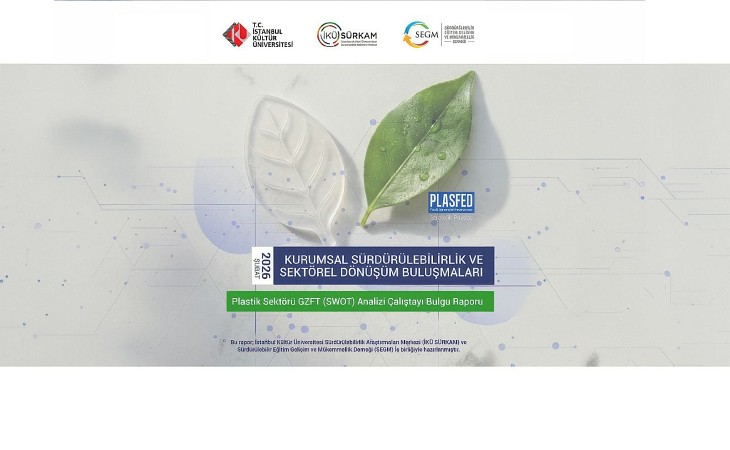
The “Plastics Sector SWOT Analysis Workshop Findings Report,” prepared within the scope of Corporate Sustainability and Sectoral Transformation Meetings, has been shared with the public. The report covers the plastics sector's strengths, areas for development, opportunities, and the risks it faces in a comprehensive manner, providing important findings that will shed light on sectoral transformation.
The Plastics Industrialists Federation (PLASFED) also took part as one of the stakeholders of the study, contributing actively to the process and playing an important role in reflecting the sector's views and evaluations in the study.
This study was carried out within the scope of the “Corporate Sustainability and Sectoral Transformation Meetings,” conducted in cooperation with the Istanbul Kültür University Sustainable Development Center (İKÜ SÜRKAM) and the Sustainable Education Development and Excellence Association (SEGM).
The Sector's Transformation Capacity Has a Strong Foundation
The prepared report reveals that the plastics sector has a solid potential for transformation thanks to its strong production infrastructure, technological adaptability, and wide range of use areas. However, it is emphasized that not only production capacity but also environmental compliance, access to finance, data-based management, and a circular economy approach are critical to maintaining competitiveness with a focus on sustainability.
Increasing environmental regulations on a global scale and the transformation in the trade system make it mandatory for the sector to increase its pace of adaptation to change.
Sustainability Requires a Multi-Dimensional Transformation
The report contains strategic recommendations for the future of the sector by offering a comprehensive roadmap in areas such as the circular economy, carbon management, digitalization, sustainable product design, human resource transformation, and social perception management. In this context, a transformation process is indicated that will secure not only the current competitiveness of the plastics sector but also its long-term sustainable growth.
Acknowledgments
We would like to thank all the academics, sector representatives, and stakeholders who contributed to the realization of this valuable study, especially SEGM Chairman of the Board Çağlar Çabuk, Istanbul Kültür University Rector Prof. Dr. Fadime Üney Yüksektepe, and Vice Rector Prof. Dr. Burcu Yavuz Tiftikçigil.
To examine the report, you can access it by visiting the reports section on our website.
PLASFED Communication Consultancy
This content has been translated using artificial intelligence technology.