




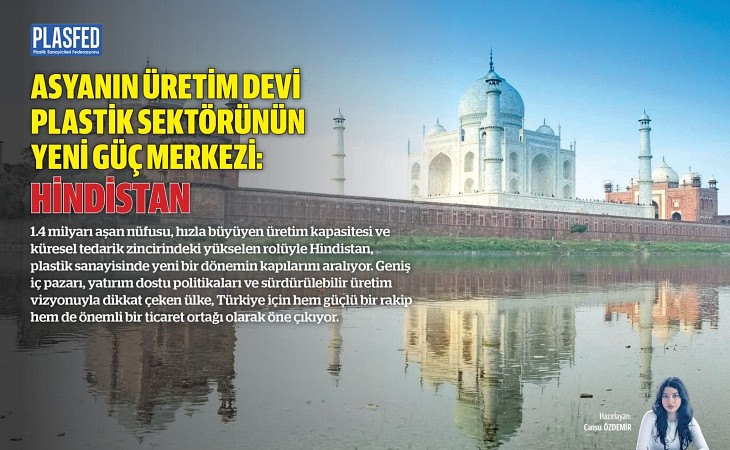
ASIA'S PRODUCTION GIANT, OF THE PLASTICS INDUSTRY
NEW POWER CENTER:
INDIA
With a population exceeding 1.4 billion, rapidly growing manufacturing capacity, and an escalating role in the global supply chain, India is opening the doors to a new era in the plastics industry. Standing out with its vast domestic market, investment-friendly policies, and sustainable production vision, the country emerges as both a formidable competitor and a significant trading partner for Turkey.
As the world's most populous country, India has become one of the most striking actors in the global economy in recent years, not only with its population but also with its rapid rise in industrial production. Increasing its manufacturing capacity in line with the "Make in India" vision, the country is rapidly expanding the use of plastics in many fields, from automotive and electronics to packaging and healthcare. Today, the Indian plastics industry is gaining an increasingly greater say in the global market thanks to strong domestic demand, a young workforce, investment incentives, and an export-oriented growth model. At the same time, the steps it takes regarding sustainable production, recycling, and bioplastics provide important clues about the future of the sector.
From Turkey's perspective, India stands out as one of the strategic markets where both competition and cooperation are possible. The two countries' similar production capabilities, different scale advantages, and complementary sectors bring new trade opportunities.
ONE OF THE FASTEST GROWING PLASTICS MARKETS IN THE WORLD
In an era where global production balances are being reshaped in recent years, India is among the countries that draw attention with its rise in the plastics industry. Thanks to its large population, increasing consumption habits, and government support for industrial production, the country stands out as one of Asia's most dynamic plastics markets. The plastics industry is considered today as one of the important elements of economic growth, industrialization, and export strategy.
Home to over 50,000 plastic processing enterprises, SMEs make up the majority of the sector in India. Large petrochemical companies such as Reliance Industries, GAIL, and Haldia Petrochemicals support the growth of the sector through capacity increases and production aimed at international markets.
While the packaging sector ranks first in plastic usage, the growth of e-commerce, ready-to-eat food, and organized retail increases the demand for packaging solutions. The increase in production in the automotive, white goods, health, construction, and electronics sectors also supports the need for plastic products.
According to experts, one of India's most important advantages is its domestic market, which has not yet reached saturation. Increasing urbanization, the expanding middle class, and the growth potential in per capita plastic consumption make the country an attractive center for both manufacturers and international investors.
"MAKE IN INDIA" POLICY AND PRODUCTION MOVE
At the root of the momentum India has caught in industry lies the "Make in India" program launched in 2014. Implemented to encourage domestic production, attract foreign investments, and transform the country into a global manufacturing hub, this strategy also accelerated the development of the plastics and petrochemical sectors.
Within the scope of the program, investment processes were facilitated, regulations regarding foreign capital were simplified, and significant investments were made in industrial infrastructure. While the production and logistics infrastructure was strengthened through plastic processing clusters, organized industrial zones, and special economic zones, it was aimed for supply chains to operate more efficiently.
This transformation, alongside increasing production capacity, accelerated technology transfer, encouraged modern machinery investments, and strengthened the sector's compliance with international quality standards.
TURKEY AND INDIA: A COMMON PATH RANGING FROM COMPETITION TO COOPERATION
Although Turkey and India are two important manufacturing countries operating on different scales in the plastics industry, they bear striking similarities in terms of the basic dynamics of the sector. While both countries stand out with their strong plastic converter industries, wide product ranges, and flexible production capabilities, their common features include being dependent on petrochemical raw materials to a certain extent and developing strategies to increase value-added production.
While the packaging sector ranks first in plastic consumption in both countries, the automotive, white goods, construction, agricultural, and medical sectors are among the main areas supporting demand. With the strengthening of the sustainable production approach, investments in recycling technologies, circular economy applications, and eco-friendly materials are also on the common agenda of both countries.
The most important factor separating the two countries from each other is production scale and market size. With a population of approximately 1.4 billion, India strengthens its position in the global plastics industry with its wide domestic market and competitive production structure, while Turkey provides a competitive advantage in the international market with its strategic geographical location, short delivery times, high quality standards, and strong engineering infrastructure.
NEW PAGE IN TURKEY-INDIA TRADE
While economic relations between Turkey and India have gained a stable momentum in recent years, contacts in the industrial field are also transforming into a more institutional structure. Especially the plastics industry harbors significant potential in terms of mutual investment, technology sharing, and production collaborations.
Petrochemical raw materials, plastic products, machinery and equipment, and mold technologies constitute the prominent product groups in trade between the two countries. In addition, technologies providing efficiency in production processes and advanced engineering solutions expand the scope of cooperation.
Sectoral fairs, trade delegations, and B2B meetings offer important platforms in terms of companies developing new business partnerships and evaluating investment opportunities. Recycling technologies, extrusion systems, automotive and medical plastics, and smart packaging solutions are shown among the prominent areas for joint R&D and technology development studies.
A PLASTICS ECOSYSTEM OPENING TO THE WORLD WITH FAIRS
India also supports its growth in the plastics industry with international fairs and sectoral organizations. Fairs held across the country bring together raw material manufacturers, machinery manufacturers, recycling technology companies, and the packaging sector, creating important platforms where new technologies are introduced and commercial collaborations are developed.
PlastIndia, foremost IndiaPlast, PlastFocus, and regional industrial fairs host thousands of visitors and international participants every year, introducing India's production capacity and technological development to the world.
For the Turkish plastics industry, these fairs hold strategic importance in terms of reaching new customers, following technological developments, analyzing investment trends, and establishing direct contact with potential business partners in the Asian market.
FROM TRADITIONAL STRUCTURE TO MODERN SYSTEM IN RECYCLING
India has had one of the world's largest informal recycling networks for many years. Street pickers, small-scale businesses, and local recycling networks play an important role in bringing plastic waste into the economy. This system, which largely operated informally in the past, has been tried to be transformed into a more planned and sustainable structure in recent years.
While the responsibilities of producers in waste management are increased with the Extended Producer Responsibility (EPR) system, practices for digitally tracking recycling processes are becoming widespread. Investments made in modern recycling facilities also aim to increase the use of recycled raw materials in industry.
However, millions of tons of plastic waste are generated every year due to rapid urbanization and increasing consumption. Therefore, industry representatives point out that in addition to recycling investments, separating waste at the source, increasing consumer awareness, and spreading circular economy practices are of critical importance.
YOUNG POPULATION, INCREASING CONSUMPTION, AND GROWING DOMESTIC MARKET
The most important factor highlighting India's plastics industry is its constantly growing domestic market. The young population, which constitutes a significant portion of the approximately 1.4 billion population, increases the demand for plastic products with changing consumption habits. Urbanization, the growth of the middle-income group, the development of modern retail, and the spread of packaged product consumption also support this process.
While growth in packaged food, personal care, health, agriculture, and e-commerce sectors increases the need for plastic products, the spread of online shopping strengthens the demand for safe packaging solutions, and developments in the health sector strengthen the demand for single-use medical plastic products.
Experts predict that in the coming years, India will shape the global plastics industry not only with its production capacity but also with its consumption power. The fact that per capita plastic consumption remains behind developed countries presents significant growth potential for the sector.
BOX
Let's Get to Know India
- Population: The world's most populous country exceeding 1.4 billion
- Capital: New Delhi
- Official Languages: Dozens of official languages, primarily Hindi and English
- Economy: Ranks among the top positions in the world's largest economies.
- Strong Sectors: Plastics, petrochemicals, automotive, pharmaceuticals, textiles, information technologies, and electronics.
INDIA PLASTICS INDUSTRY AT A GLANCE
Largest area of use → Packaging
Strong sectors → Automotive • Electronics • Medical • Construction
Advantages → Large domestic market • Young workforce • Investment incentives
Challenges → Waste management • Raw material need • Infrastructure differences
Opportunities for Turkey → Machinery export • Recycling technologies • Joint production • High value-added plastic products
Box
will be located at the very beginning of the page
GDP $4.2 trillion
GDP Growth Around 6.5%
GDP Per Capita $2,900
Inflation Around 4.5%
Unemployment Around 5%
Official Name Republic of India
Surface Area 3.29 million km²
Language Hindi and English (official languages)
Population 1.46 billion
Currency Indian Rupee (INR)
Export Volume $430 billion (goods export)
Import Volume $690 billion (goods import)
This content has been translated using artificial intelligence technology.